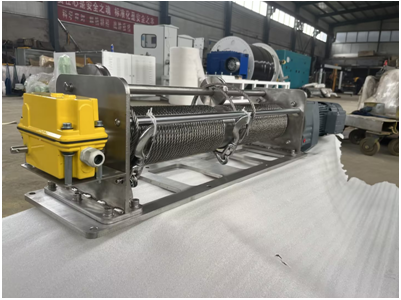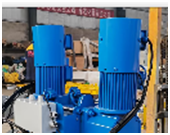
High-Speed Traction Winch | 500 kg Light-Duty High-Speed Traction Solution with VFD Control
The more projects I work on, the more interesting patterns I notice.
In many systems, the required pulling force is not very high, but speed and cycle time matter far more, for example:
- Hundreds or even thousands of back-and-forth cycles per day
- Each stroke is not extremely short, while idle return strokes take most of the time
- The equipment itself is valuable — users fear “slow” more than they fear whether a few hundred kilograms of pulling force is enough
In such scenarios, if you still follow the traditional logic of “bigger tonnage = better”, you will quickly run into problems:
- Tonnage increases
- But the speed cannot keep up
- Operators and clients feel the system is “holding them back”
This high-speed traction winch is designed exactly for these “light load but extremely speed-sensitive” applications:
- 18.5 kW VFD motor
- Rated traction: 500 kg
- Top rope speed: 120 m/min
- Built-in VFD, stepless speed control via a simple knob
- Smooth control in both rope-in and rope-out motions
Below I will share, based on my real project experience:
- What types of applications truly benefit from this winch
- And how you should provide parameters for proper selection
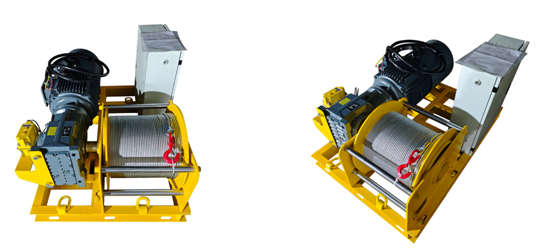
I. Applications Where a High-Speed Traction Winch Truly Excels
1) High-frequency reciprocating traction: Speed = Productivity
Certain use cases are so typical that I can determine whether this winch fits as soon as I hear them:
- Rail-mounted tooling carts or testing trolleys moving back and forth
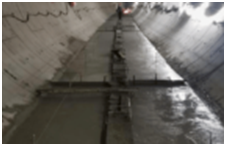
- Test lines, aging lines, or laboratory rigs requiring frequent reciprocating motion
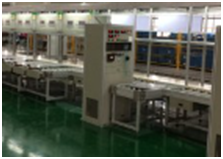
- Auxiliary traction mechanisms beside production lines where each cycle must sync with the main machine
Common characteristics:
- Loads are light — a few hundred kilograms at most
- Frequent reciprocation — hundreds or thousands of cycles daily
- The biggest complaint is always “too slow”, not “not strong enough”
So for these cases, our design philosophy is:
- Fix the rated traction at 500 kg
- Allocate the motor power & structural optimization to higher speed
- Let the whole system run more “freely and efficiently”
2) Long-travel light-load traction: Idle travel time must be minimized
Another category involves long travel distance but still low load:
- Small testing carts moving along long corridors
- Long-distance hose/cable wire deployment & retrieval
- Moving a device from point A to a far point B, but with minimal load
With a normal-speed winch, the biggest challenge is idle travel consumes most of the cycle:
- First, you must send the rope hook all the way to the working point
- After operation, the rope must be retracted fully to prepare for the next cycle
The “loaded working time” may be only a small portion of the entire cycle.
High-speed traction winches are designed to dramatically shorten this non-productive time while maintaining safe control.
3) Laboratory / testing / experimental rigs: Speed curve controllability is essential
Typical examples:
- Fatigue tensile testing rigs for materials or components
- Long-stroke displacement loading platforms
- Test systems that require specific acceleration/deceleration curves
In such scenarios:
- Load is small
- But requirements for speed stability, repeatability, and adjustability are very high
Our built-in VFD allows:
- Stepless speed control using a knob
- Operation from high-speed near 120 m/min
- Down to low-speed modes for fine adjustments
Very friendly for testing, calibration, and experimental environments.
II. Why intentionally design “High-Power, Light-Load, High-Speed” configuration?
The most common question people ask is:
“18.5 kW motor for just 500 kg traction? Isn’t that overkill?”
Yes — but intentionally.
My reasoning:
1. Light load + high motor power = greater safety margin & speed potential
- Higher motor speed + higher drum surface speed
- Extra buffer for handling sudden resistance or transient acceleration needs
2. Setting the load class at 500 kg allows optimization for “speed-focused” structures
- Drum diameter, rope diameter, guide system, cooling, and structural stiffness
- All can be designed around high-speed operation
- No need for “heavy industrial” structures sized for several tons
3. VFD makes high power controllable, not risky
- Soft start and soft braking
- Smooth rope-in and rope-out
- Operator controls speed easily through the knob
In essence, this winch is more like a high-performance motion actuator rather than a traditional “tonnage-based” winch.
III. If you want me to select this winch for your project, here’s what I will ask
To simplify selection and quotation, I usually ask the following questions.
You can also copy this list directly to send your working conditions:
- What are you pulling/driving?
Trolley? Test bench? Hose? Cable? Custom mechanism? - Maximum pulling load?
Actual mass + friction (rolling/sliding) + slope (if any) - Desired maximum speed?
Any strict cycle requirement? (e.g., “complete X meters within Y seconds”) - Travel distance per cycle?
Stroke per trip & number of cycles per day - Speed control requirements?
Just “faster”? Or specific speed range / multi-segment velocity profile? - Planned control method?
Button box / speed knob / integration with PLC - Installation space & rope direction
Winch mounting location, rope exit direction, need for sheaves or guide pulleys
With this information, I can determine:
- Whether this high-speed traction winch suits your application
- Whether traction force, rope diameter, or rope length needs adjustment
- Whether to use our integrated VFD control box or interface with your PLC
IV. What parameters can be customized for your project?
The configuration 500 kg / 18.5 kW / 120 m/min / 8 mm rope is an example.
We can adjust:
- Load class (within a defined range)
- Speed range (according to your cycle requirements)
- Rope length (drum size / rope diameter adjustable)
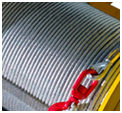
- Rope exit direction:
front / rear / upward / with guide pulley
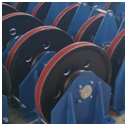
- Control options:
integrated VFD box or PLC terminals
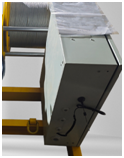
- Material & protection:
outdoor, corrosion-resistant, dust-proof, etc.
This winch is not a “fixed-parameter standard product”
but a customizable platform for speed-critical applications.
V. Working Condition Inquiry Template (Ready to Copy)
Feel free to use this as an email template (also suitable for English inquiries):
High-Speed Traction Winch Selection Request
- Traction object: (rail trolley / test bench / hose / cable / etc.)
- Max pulling load: ____ kg (rolling or sliding? any slope?)
- Travel per stroke: ____ m; cycles per day: ____
- Desired max rope speed: ____ m/min; speed control requirement: ______
- Installation space: L ____ mm × W ____ mm × H ____ mm
- Power / control method: need VFD control box or integrate into my PLC
- Environmental requirements: outdoor / anti-corrosion / dust-proof / explosion-proof
With this information, I can provide a tailored preliminary solution during the first communication.
Final Note
This high-speed traction winch is not meant to compete in tonnage with multi-ton winches.
Its real purpose is to solve the problem:
“When your load is not heavy, but speed, cycle time, and controllability are extremely important — how to achieve a fast, stable, controllable traction system.”
If you have such a project, feel free to share the working conditions.
We can evaluate together:
- Whether this winch fits your scenario
- And how to configure it to run fast and stable