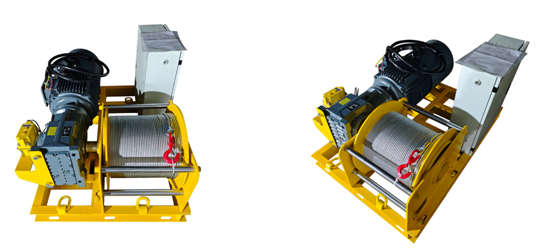
How to Select the Right Industrial Winch for Your Production Line or Warehouse System
When engineers search for an industrial winch, they are rarely buying a standalone unit.
In most cases, they are looking for an equipment-integrated winch that works as part of a:
- Production line or assembly line
- Warehouse shuttle or rack system
- Lifting platform or hoisting frame
- Positioning or tensioning mechanism
Choosing the wrong winch can slow down your takt time, cause wire rope damage and overheating, or even create safety risks.
This winch sizing guide walks you through how to select an industrial winch step by step—covering
line pull calculation, rope speed, drum capacity, duty cycle, automation and environment—so you can send a clear
requirement list and get accurate proposals from suppliers.

1. Define the Task Type: Pulling, Hoisting or Tensioning?
The first step in how to select an industrial winch is to define what the winch actually does in your system.
Different tasks require different safety factors, braking methods and rope structures.
Task Type 1 – Pulling / Towing Winch
This is the most common use case for equipment-integrated winches:
- Pulling assembly carts along a track
- Driving conveyor or transfer carts between stations
- Moving shuttle carriers in warehouse rack systems
- Horizontal pulling of work platforms or maintenance trolleys
Here, the winch is more about horizontal traction and controlled movement than vertical lifting.
Task Type 2 – Hoisting / Lifting Winch
If your winch is used as a hoisting winch, design requirements are stricter:
- Lifting platforms and work stages
- Auxiliary lifting of jigs, molds or heavy modules
- Precise elevation for alignment and positioning
A hoisting winch normally requires higher safety factors, specific braking systems and stricter standards for rope selection.
Task Type 3 – Positioning / Tensioning Winch
A positioning or tensioning winch is widely used in:
- Jig or fixture clamping tension
- Rewinding and tension control for cables, hoses or web materials
- Fine positioning of a working device or platform
These systems often need stable low speed, small movement increments and sometimes closed-loop control.
Key takeaway: Before searching “industrial winch for production line” or “winch for warehouse shuttle system”,
classify your task as pulling, hoisting or tensioning—it changes almost every design parameter.
2. How to Calculate Winch Line Pull (Step-by-Step)
One of the most searched questions is “how to calculate winch line pull?”
In real projects, the most important value is not the catalogue tonnage, but the actual working line pull your system needs.
A simple engineering approach:
Base Line Pull = Load × Friction Coefficient
+ Slope Resistance (if any)
+ Starting Inertia + Shock Allowance
× Safety Factor (typically 1.5–2.5×)
Typical friction coefficients (for quick estimation)
- Rail / roller carts: 0.02 – 0.05
- Ground dragging: 0.20 – 0.40
- Inclined pulling: add force component based on slope (sinθ × load)
What if you use multi-reeving or pulley blocks?
- More falls → lower pull required on each line
- But effective travel and speed are reduced
- Rope routing, reeving ratio and sheave layout should be confirmed early in the design
When sending a winch selection checklist to your supplier, either provide your own line pull calculation or ask them to
calculate it based on your load, friction and route.
3. Rope Speed & Travel: Winch Sizing for Takt Time and Cycle Time
If the winch is part of a production line, its rope speed directly affects takt time and throughput.
Key parameters for winch sizing for production line
- Target rope speed (m/min) – based on allowed move time within each cycle
- Effective travel (m) – real working stroke, not just maximum rope capacity on drum
- Acceleration & deceleration profile – smooth ramping reduces mechanical shock and product damage
For applications requiring smooth motion and precise control, consider a VFD winch (variable frequency drive winch):
- Soft start / soft stop
- Adjustable multi-speed operation
- Easily integrated with PLC for automatic mode
For precision positioning winch systems, add:
- Encoders for feedback
- Limit switches for end-of-travel protection
- Closed-loop positioning logic via PLC
4. Drum Capacity, Rope Diameter and Spooling Method
A well-designed drum and rope system is key to avoiding tangled rope, localized wear and sudden shocks.
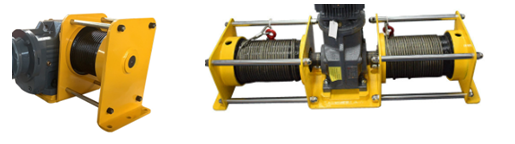
Single Drum vs Dual Drum Winch
- Single drum winch
Best for typical pulling and hoisting with a single line; suitable for short to medium travel distance. - Dual drum winch
Ideal for long-travel systems, frequent bi-directional motion, or cases where pulling and tensioning functions must be separated.
Automatic Spooling & Grooved Drum
For high-frequency short stroke applications (e.g. shuttle systems, repetitive cart pulling):
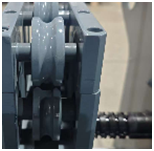
- Use automatic rope spooling or a rope guide to keep layers neat
- Choose a grooved drum to guide the rope and reduce cross-winding
Rope Diameter & Rope Type
- Match rope diameter to required line pull and drum diameter (bending radius)
- Consider rope construction and coating based on environment and wear conditions
5. Duty Cycle: Selecting Motor and Gearbox for Continuous or Cyclic Operation
Many failures in winch systems are not due to insufficient tonnage, but wrong duty cycle selection.
For a warehouse system winch or conveyor / production line winch, operation is often repetitive and long-period.
Provide your supplier with:
- Cycles per hour
- Running time per cycle
- Idle / cooling time
- Duration and frequency of peak loads
This allows them to select:
- Suitable motor duty class (S3/S4 or higher)
- Proper gearbox size and cooling capability
Ignoring duty cycle leads to overheating motors, overloaded gearboxes and early failure.
6. Control, Automation & PLC Integration for Equipment-Integrated Winches
Modern industrial winches are rarely stand-alone. They are part of a larger automation system.
Common control & integration requirements
- PLC I/O for start/stop, direction, alarm and status feedback

- Multi-speed or VFD control with adjustable ramps
- Emergency stop & braking logic integrated with safety circuits
- Multi-rope synchronization for wide frames or dual-point lifting, to prevent skew and twisting
If your plant already standardizes on specific PLC / VFD brands, share this in your
winch sizing request. Your supplier can match hardware and provide ready-to-integrate solutions.
7. Environment and Protection Class: Indoor, Outdoor, Corrosive or Hazardous?
The same mechanical winch can behave very differently in different environments.
Typical environment considerations
- Outdoor, humid, marine or corrosive
Stainless steel parts or heavy anticorrosive coatings, sealed housings for motors and electrical components. - Dusty or particle-rich environments
Dust-proof enclosures, rope protection and better sealing. - Chemical or high-temperature areas
Higher insulation class, chemical-resistant paints and materials. - Explosion-risk zones (ATEX, EX)
Explosion-proof motors and controls, certified enclosures and wiring methods.
8. Winch Selection Checklist (Ready to Copy & Send)
To speed up communication and receive a more accurate proposal, prepare a simple
winch selection checklist like this:
- Task Type: Pulling / Hoisting / Positioning–Tensioning
- Max Load (kg/ton): and whether it is rolling / sliding / shock load
- Required Line Pull: or ask supplier to calculate
- Target Rope Speed (m/min):
- Effective Travel (m): real working stroke
- Duty Cycle: cycles per hour, run time, idle time
- Rope Routing & Reeving Ratio: if pulleys are used
- Control Mode: push-button / VFD / PLC / synchronized control
- Installation Conditions: base layout, drum direction, rope entry angle, space limits
- Environment: indoor/outdoor, corrosion, dust, explosion-proof requirements
If you send these details along with layout drawings or site photos, your supplier can:
- Calculate the required line pull
- Provide 2–3 winch configuration options (single drum, dual drum, synchronized)
- Suggest structural dimensions and cabling routes
- Help you avoid redesign and repeated installation work
9. Conclusion: Treat Your Winch as a Core Actuator, Not a Simple Accessory
In modern production and warehouse systems, the winch is no longer just “a motor and a drum.”
It is a core actuator that directly influences:
- Production takt time
- System safety
- Maintenance costs and uptime
If you treat the winch as a strategic component—size it correctly, integrate it properly and match it to your environment—it will quietly
deliver long-term, stable performance.
If you are planning a new production line, a warehouse shuttle system, or a retrofit project, now is the right time to build your own
industrial winch selection checklist and talk with a specialist supplier.