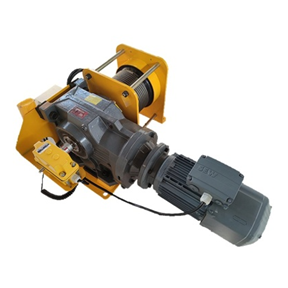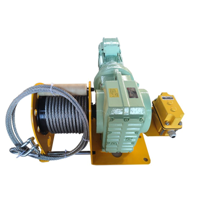
Heavy-Duty Engineering Winch Solutions | Long-Travel, Heavy-Load Industrial Winch Manufacturer KLD
Many engineering professionals bring up the same issue when talking to me about winches:
“The tonnage is high enough and the rope is long enough, but when we actually use it, it keeps overheating, making noise, and maintenance is troublesome.”
Especially for projects involving long travel, heavy loads and continuous duty, ordinary winches often show weaknesses: low efficiency, high noise, overheating of the gearbox, and inconvenient maintenance.
This heavy-duty industrial winch is developed specifically for such conditions:
using an R-series gear motor direct-drive structure, a separated electrical cabinet layout, and ultra-long wire rope configuration, designed to serve long-distance lifting and pulling in large engineering projects.

In this article, I want to explain two things clearly:
- From a selection and procurement perspective — How should this type of heavy-duty winch be selected?
- From an application and solution perspective — Which projects is it suitable for, and what real problems can it solve?
I. About the Equipment Itself: Why Design It as “Heavy-Duty and Long-Rope”?
A set of typical parameters will give you a clearer idea:
- Rated load: approx. 5000 kg
- Motor power: approx. 22 kW
- Single-drum wire rope length: up to approx. 300 m
- Wire rope diameter: approx. 20 mm
This already goes far beyond the range of ordinary small-tonnage winches; it is closer to an engineering-grade long-travel lifting/pulling platform.
1. R-Series Gear Motor Direct Drive — For Efficiency and Service Life
We use an R-series gear motor with direct output:
- High transmission efficiency and low mechanical loss, suitable for long-duration operation
- Integrated motor and gearbox structure for simplified installation and maintenance
- Higher effective output under the same power level, reducing long-term power costs
- Helical gear transmission provides lower noise — an advantage in noise-sensitive environments
2. Single-Column Structure — For Structural Rigidity and Layout Efficiency
“I-shaped” essentially means:
a heavy-duty upright column + centralized drum and drive unit, resulting in a clear overall structure:
- Drum, reducer and motor are concentrated on one side of the column, giving a short force path and excellent rigidity
- Controlled footprint, enabling long rope configurations within limited installation space
- Convenient to arrange guide pulleys, tension devices and safety protection structures around the column
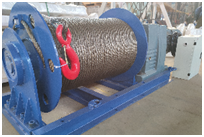
Compared with traditional “large box + low base” winches, this structure is more suitable for forming modular engineering units and integrating directly into steel structures or platforms in large projects.
3. Separated Electrical Cabinet — For Maintenance Convenience and Reliability
We intentionally designed a separate electrical control cabinet, instead of mounting everything on the machine frame:
- Daily inspection and maintenance do not require crawling under the machine; maintenance space is larger
- Electrical components can be positioned away from high-vibration and high-dust areas, extending service life
- When complex control (VFD, PLC linkage, interlocking) is needed, wiring and modification become easier

4. Ultra-Long Rope Design — Truly “Engineering-Grade”
In standard cases, we provide approx. 300 m rope capacity. For engineering projects, this is a meaningful level:
- Suitable for long-distance pulling and lifting: height differences of tens or even hundreds of meters
- Compatible with multi-stage guide pulley systems for complex routing
- With engineering redesign, rope length can go beyond this range by adjusting rope diameter and drum design

II. Selection/Purchasing Perspective: How Should a Heavy-Duty Industrial Winch Be Selected?
If you are considering using this equipment in a project, start with the following key points.
1. First Clarify the “Action Task”: Lifting, Pulling, or Reciprocating Tensioning?
These three motions have major impact on selection:
Hoisting (vertical or near-vertical lifting):
Lifting structures, platforms or heavy components.
Long-distance pulling:
Dragging equipment or materials on slopes, tunnels, corridors, or near waterfronts.
Reciprocating/tensioning:
Cable/hose winding and tensioning; long-travel platform reciprocation; positioning tasks.
Different tasks require different braking methods, safety factors, control strategies, and drum designs.
If you clarify the task in one sentence, it greatly improves the accuracy of the solution.
2. Load Is Not Only “5 Tons”
Although the standard case shows 5000 kg load, parameters such as load, speed, rope length, rope exit direction and materials are all customizable.
For engineering selection, we care more about:
- Maximum working load and whether impact loads exist
- Single-point lifting or multi-point/multiple-sheave lifting
- Whether the duty cycle is short-duration high load, long-duration medium load, or near continuous full load
Based on this information, we recommend a proper safety factor and rated capacity — instead of simply using “rated load ≥ actual load × factor.”
3. Key to Long Travel: Rope Length + Speed + Duty Cycle
For this heavy-duty winch, long travel is one of its strengths, but long travel is not just how many meters the drum can hold.
You must consider:
- Maximum single-stroke travel (effective working distance, excluding safety wraps)
- Desired lifting/pulling speed (m/min)
- Operation frequency per hour/day (determines duty class and motor selection)
- Whether constant speed is acceptable or VFD control is required for soft start/stop and segmented speed control
Long travel + heavy load + frequent operation, if mismatched, easily causes motor overheating, reducer overload and brake fatigue.
This product is designed to balance these three factors.
4. Control and Protection — Whatever You Need Can Be Integrated
Control options include:
- Traditional pendant station or push-button control
- VFD speed control (multi-speed, soft start/stop, fault protection)
- PLC integrated control (communication with upper-level systems and interlocks)
- Wired/wireless remote control
- Limits, tension monitoring, encoder speed feedback, etc.
We can combine these modules based on your project requirements:
You may want a simple, safe logic or a full VFD + PLC + synchronized multi-point engineering scheme.

III. Application/Solution Perspective: Where Does This Heavy-Duty Winch Fit?
Scenario 1: Long-Distance Lifting and Pulling in Large Engineering Projects
Typical examples:
- Transporting large steel structures or modules across height differences on construction sites
- Long-distance pulling/lifting operations in hydropower, energy or infrastructure projects
- Material movement and equipment relocation in tunnels, shafts or inclined shafts
Common issues:
- Large lifting height or pulling distance; ordinary winches lack rope capacity
- Need for long-duration operation; high requirements for motor and gearbox
- Harsh environments and limited maintenance conditions; desire for high reliability
This heavy-duty winch solves these by enabling long rope + heavy load + long-duty performance with a separated electrical cabinet for easier maintenance.
Scenario 2: Long-Distance Material Pulling in Ports, Docks and Large Industrial Plants
Such as:
- Dragging roll-on equipment or sliding platforms over long distances in piers or yards
- Transferring large components between stations in large factory areas
- Pulling operations requiring both speed and stable continuous motion
Here, rope length and efficiency are crucial:
- 300 m-level rope can cover most single or multi-segment pulling routes
- VFD allows smooth acceleration/deceleration, reducing structural and rope impact
- structure is easy to integrate into platforms or truss structures
Scenario 3: Deep Integration into Steel Structures or Equipment Systems
Some projects require the winch to be part of a larger system:
- Mounted on steel platforms, towers, guide rails or trusses
- Supporting multi-point lifting, multi-direction pulling or complex paths
- Integrated with PLC or safety systems for interlocks and linkage
Advantages of the winch here:
- Concentrated structure and clear force path for structural design
- Flexible placement of control cabinet for wiring and maintenance
- All parameters—load, speed, rope length, control—can be customized around the system
For such projects, our work is more like co-designing the whole solution with your engineering team.
IV. If You Want to Configure This Winch, Include at Least These in Your Inquiry
Prepare the following for an efficient preliminary proposal:
- Project industry and working environment (bridge, tunnel, hydropower, port, factory, etc.)
- Task type (lifting / pulling / tensioning / multi-point linkage)
- Maximum load and whether impact loads exist
- Expected travel and speed range
- Operation frequency (runs per hour/day)
- Installation space, structural form (ground, platform, truss)
- Power conditions and whether VFD/PLC is needed
- Requirements for anti-corrosion, protection, explosion-proof, etc.
With this information, we can prepare:
- Load and safety factor analysis
- 1–2 recommended configurations
- Structural arrangement and rope routing suggestions
- Pricing and lead-time estimates
V. Final Note: For This Level of Winch, Never Look Only at “Tonnage” and “Price”
A heavy-duty industrial winch is designed for long travel + heavy load + engineering-level tasks.
If you compare only “5 tons vs 5 tons” or only the unit price, it’s easy to fall into pitfalls:
either the winch struggles in real use, overheats, or the long-term maintenance cost and downtime far exceed the equipment cost.
I prefer treating this product as an engineering solution rather than a standalone device:
- First clarify load, travel, speed, duty cycle and control requirements
- Then back-calculate the proper selection
- Only after that compare pricing, lead time and service
If you already have a project, simply list the above information, and I can help you check:
- Whether this heavy-duty winch is suitable
- And if so, how to configure it correctly so it truly matches the level of your project