
Automatic Cable-Paying Umbilical Winch Solution | 300-metre Composite Cable Management System

I. Project Background
During the operation of many specialised pieces of equipment, terminal devices often need to remain connected to the control system via composite cables (umbilical cables) .
These composite cables typically fulfil multiple functions simultaneously:
- Power transmission
- Communication signals
- Data control
- Water supply lines
- Gas supply lines
Consequently, in the industrial sector, such cables are commonly referred to as 'umbilical cable systems' .
For example:
- Remotely Operated Vehicles (ROVs)
- Airship testing systems
- Industrial inspection robots
- Automated inspection equipment
During the operation of these devices, cable lengths often range from tens to hundreds of metres. Without specialised cable management equipment, the following issues are likely to arise:
- ❌ Cable tangling
- ❌ Disorganised cable arrangement
- ❌ Cable wear
- ❌ Unstable power supply
Consequently, an increasing number of engineering projects are adopting umbilical winch systems to ensure reliable cable management.
II. Client's Core Technical Requirements
In this project, the client requires umbilical winch equipment for a set of equipment testing systems. The primary requirements include:
- Support for composite cable management: The equipment must be capable of handling composite cable/water pipe/air pipe assemblies.
- Support for long-distance cables: The system must support a maximum cable capacity of 300 metres.
- Automatic cable alignment: Cables must be kept neatly arranged to prevent tangling.
- Rotational power supply: Power supply and signal transmission must be maintained whilst the drum is rotating via a slip ring.
- Real-time monitoring of operating status: The equipment must be equipped with:
- A cable meter
- Tension detection
III. KLD Solution
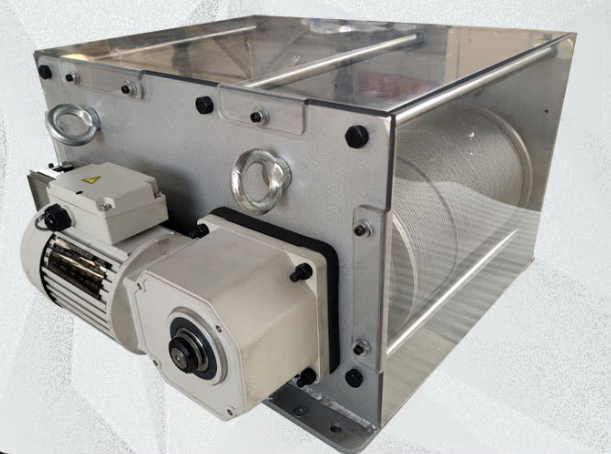
In response to the client's requirements, KLD has designed an automatic cable-laying umbilical winch system. This system is primarily intended for composite cable management and robotic power supply systems.
The system primarily comprises:
- Drum system
- Automatic cable-laying mechanism
- Drive motor system
- Slip ring power supply system
- Metering system
- Tension detection system
During operation: The cable is evenly arranged via the automatic cable-laying mechanism. Simultaneously, the slip ring system enables the transmission of power and signals whilst the drum is rotating. This ensures stable operation of the equipment.
IV. Key Technical Parameters
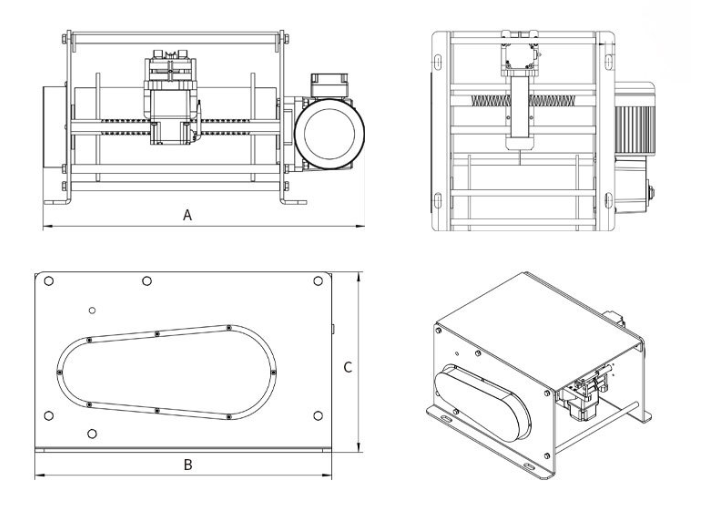
| Parameter | Specification |
|---|---|
| Rated Traction Force | 250 kg |
| Motor Power | 1.1 kW |
| Wire Rope Diameter | 4 mm |
| Maximum Rope Capacity | 300 m |
| Drum Speed | 24 rpm |
| Average Speed | 15.3 m/min |
| Total Weight | 71 kg |
| Dimensions (L×W×H) | 732×650×490 mm |
V. Product Design Highlights
- Automatic Cable Arrangement System: The equipment utilises a reciprocating lead screw cable arrangement structure. This enables automatic cable arrangement and neatly arranged cable layers, preventing cable tangling. It is particularly suitable for composite cable management.
- Slip Ring Power Supply System: The equipment is fitted with an industrial-grade slip ring system. Its functions include enabling rotary power supply, ensuring stable communication signals, and supporting multi-cable connections. It is widely used in robotic power supply systems.
- Cable Length Measurement System: The equipment is fitted with a cable length meter. It enables real-time monitoring of cable length and operational distance, facilitating on-site management.
- Tension Monitoring System: The equipment is fitted with a force sensor. It enables real-time monitoring of cable tension and equipment load, enhancing operational safety.
- Transparent Guard Cover Design: The winch exterior features a transparent PC guard cover. Advantages include equipment protection, prevention of foreign object ingress, and convenient observation of operating status.
- All-Metal Welded Structure: The equipment utilises a high-strength metal welded structure. Features include high strength, excellent seismic resistance, and long-term operational stability.
VI. Application Scenarios
This umbilical winch is widely used in the following industries:
- Remotely Operated Vehicles (ROVs) : Used for equipment towing and power supply.
- Airship testing systems: Used for ground power supply to airships.
- Industrial robots: Used for robot power supply and communication.
- Automated testing equipment: Used for cable management in testing equipment.
VII. Project Value
Through this umbilical cable winch system, customers have successfully achieved:
- ✔ Stable management of composite cables
- ✔ Automatic cable reeling operation
- ✔ Rotating power supply capability
- ✔ Cable length monitoring
- ✔ Tension monitoring and protection
Compared to traditional winches, this system offers significant improvements in stability, safety and automation. KLD can provide customised umbilical winch solutions tailored to client requirements.
VIII. FAQ
Q1: What is an umbilical winch?
An umbilical winch is a device used to manage composite cables, enabling cable reeling and unwinding, automatic cable routing, and rotary power supply.
Q2: Why does an umbilical cable winch require a slip ring?
The slip ring maintains power supply and signal transmission whilst the drum is rotating.
Q3: Does an umbilical cable winch require automatic cable lay?
Yes. Composite cables are relatively thick, and without a cable lay mechanism, they are prone to tangling or damage.
Q4: Can umbilical cable winches be customised?
KLD supports customisation according to customer requirements: Pulling force, Cable length, Cable guiding structure, Control method, Slip ring specifications.
Q5: In which industries are umbilical winches suitable?
They are primarily used in: Marine equipment, Underwater robots, Airship testing, Industrial robots, Automation equipment testing.

