
Why Do Underwater Robots Need Umbilical Cable Winches? A Single Cable Winching System Solves Power and Communication Challenges
I. Project Background and Industry Challenges
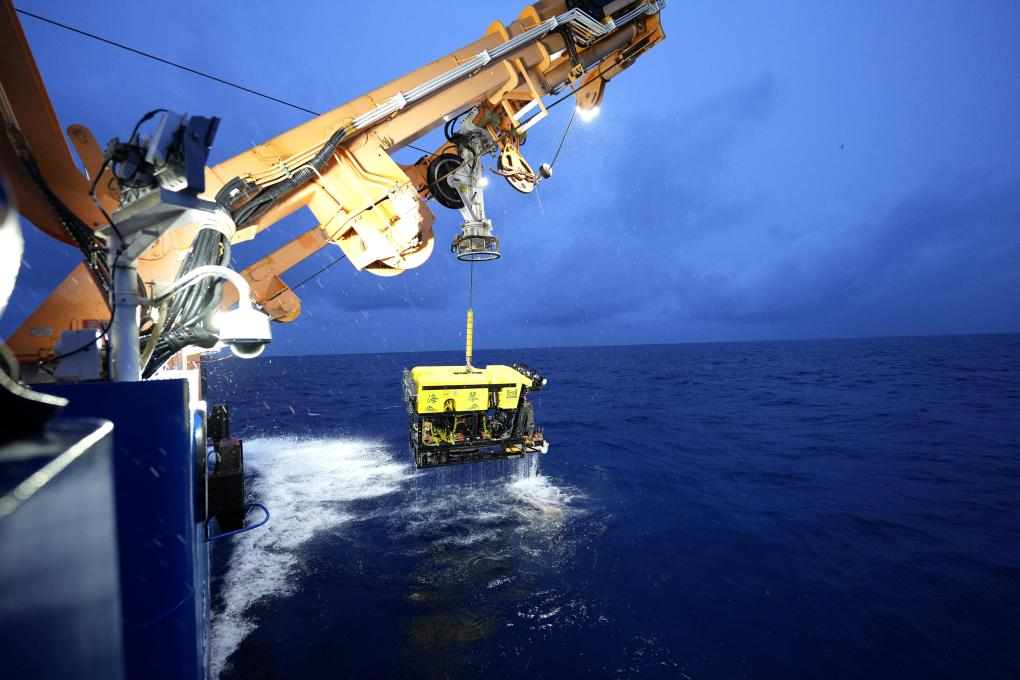
In many underwater robot (ROV) testing and operational systems, equipment typically needs to be connected to shore-based control systems via umbilical composite cables.
Umbilical cables not only transmit power but also handle:
- Data communication
- Video signal transmission
- Water or gas supply
- Control signal feedback
However, in practical applications, as operational distances increase, cable management issues gradually emerge:
Common problems include:
- Cable tangling and knotting
- Unstable deployment and retrieval
- Severe cable wear
- Difficulty in precisely controlling cable length
Without specialized equipment to manage the cable, not only will operational efficiency be compromised, but equipment damage may also result.
Therefore, an increasing number of underwater equipment systems are equipped with dedicated umbilical cable winch systems.
II. Client's Core Technical Requirements
A marine equipment R&D unit conducting tests on an unmanned underwater vehicle (UUV) put forward the following core requirements:
1️⃣ Capable of stable deployment and retrieval of composite cables
2️⃣ Supports long-distance cable management
3️⃣ Neat cable arrangement to prevent tangling
4️⃣ Real-time monitoring of cable length
5️⃣ Stable power supply even while the cable is rotating
Additionally, the equipment must be capable of operating in a long-term, continuous testing environment.
III. KLD Customized Solution
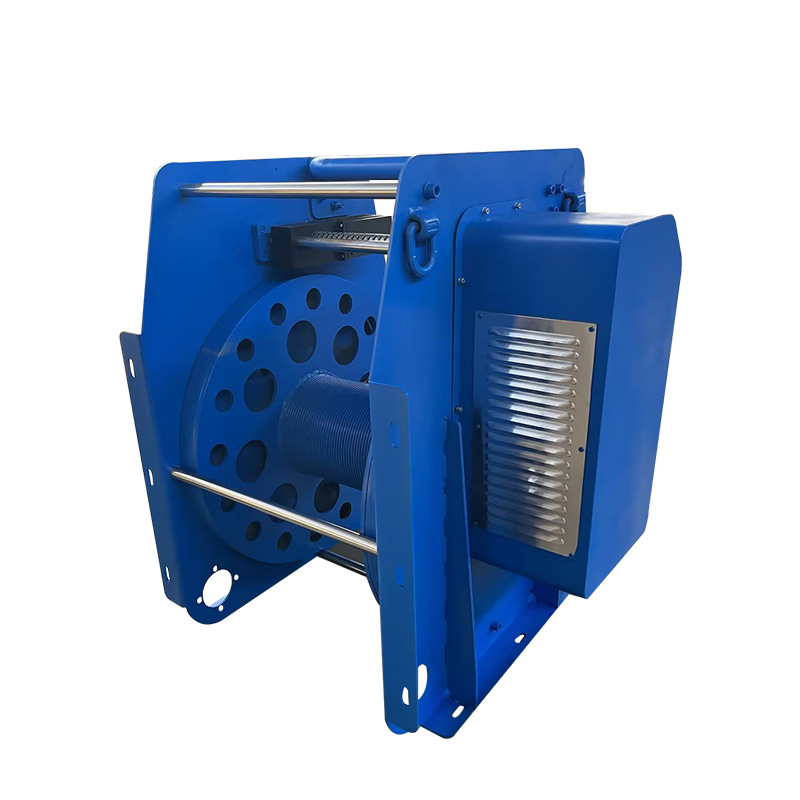
To address the above requirements, KLD designed a dedicated cable winch system for the client.
The complete system primarily consists of the following components:
- Electric drum system
- Automatic cable feeding mechanism
- Meter counter system
- Force sensor
- Slip ring power supply system
- Electrical control system
The most critical component is the composite cable slip ring structure.
The slip ring enables:
- Stable power supply and signal transmission even while the equipment is rotating.
At the same time, the automatic cable feeding mechanism ensures:
- Cables are neatly arranged on the drum, preventing tangling.
IV. Key Technical Specifications
| Item | Specification |
|---|---|
| Rated Tensile Force | 300 kg |
| Cable Diameter | 6 mm |
| Cable Length | 330 m |
| Motor Power | 2.2 kW |
| Winding/Unwinding Speed | 45 rpm |
| Cable Laying Speed | 40--60 m/min |
| Equipment Weight | 300 kg |
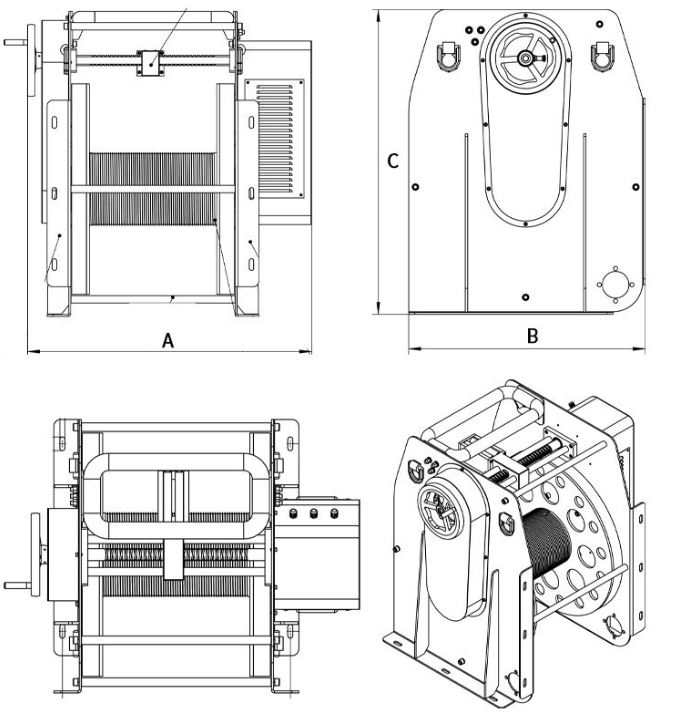
| Equipment Dimensions | 980×770×1218 mm |
V. Product Design Highlights
✔ Automatic Cable Laying System
The cable laying mechanism controls cable positioning to ensure even distribution.
Prevents:
- Cable overlapping
- Cable tangling
- Jamming during winding/unwinding
✔ Composite Cable Slip Ring System
The slip ring structure enables:
- Dynamic power supply
- Signal transmission
- Long-term stable operation
- Suitable for composite cable systems
✔ Quiet Motor Drive
The equipment utilizes a highly reliable motor drive system, featuring:
- Stable operation
- Low noise
- Long service life
✔ Cable Protection Design
The equipment is equipped with a cable guidance and protection structure that effectively reduces cable friction.
Significantly extends cable service life.
VI. Application Scenarios
This type of umbilical winch is widely used in:
- Underwater robot testing systems
- ROV towing operations
- Airship testing equipment
- Marine equipment testing platforms
- Various robotic power supply systems
VII. Summary of Project Value
By configuring the KLD cable winch system, customers have successfully achieved:
✔ Stable management of long-distance cables
✔ Improved testing system stability
✔ Reduced cable wear
✔ Enhanced equipment safety
This system has become a critical component in underwater equipment testing systems.
FAQ
Q1: Can the umbilical cable winch be customized?
Yes, KLD supports customization based on parameters such as cable diameter, length, and tensile strength.
Q2: Can the winch be used with composite cables?
Yes, the equipment is equipped with a slip ring system and is suitable for composite cables.
Q3: Does the winch come with an automatic cable pay-off system?
Yes, the equipment comes standard with an automatic cable pay-off system.
Q4: What is the maximum cable length it can handle?
Depending on the drum size, it can be designed to accommodate cable lengths ranging from hundreds to thousands of meters.
Q5: Does it support robotic power supply systems?
It can be widely applied to robotic power supply and communication systems.

