Solution for a Dual-Drum Synchronous Hoist System for Personnel Lifting in Power Maintenance | Wuhan Ruijiu Power Technology Engineering Case Study
I. Case Introduction
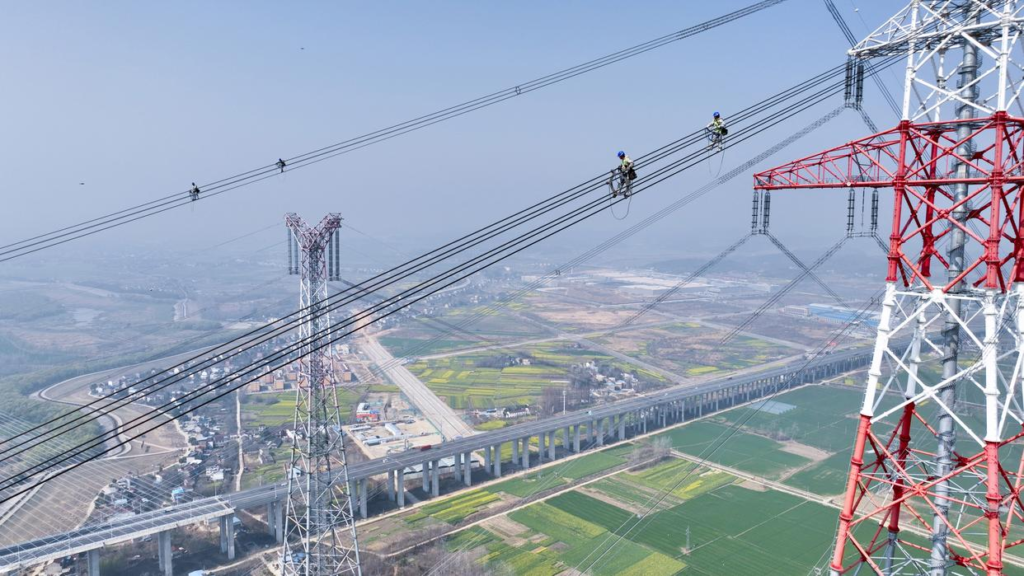
In the installation and maintenance of power facilities, the safety and stability of personnel lifting equipment are directly linked to the safety of construction workers.
In 2024, Wuhan Ruijiu Power Technology was commissioned to undertake a specialised power maintenance project, requiring a customised dual-hoist-point personnel hoisting system for lifting personnel to a height of 30 metres. The core project requirements included: a rated pulling force of 2,000 kg, an operating speed of 8 m/min, a working stroke of 30 m, whilst ensuring that the two hoist points maintained a strict distance of 2,400 mm and operated in synchronisation.
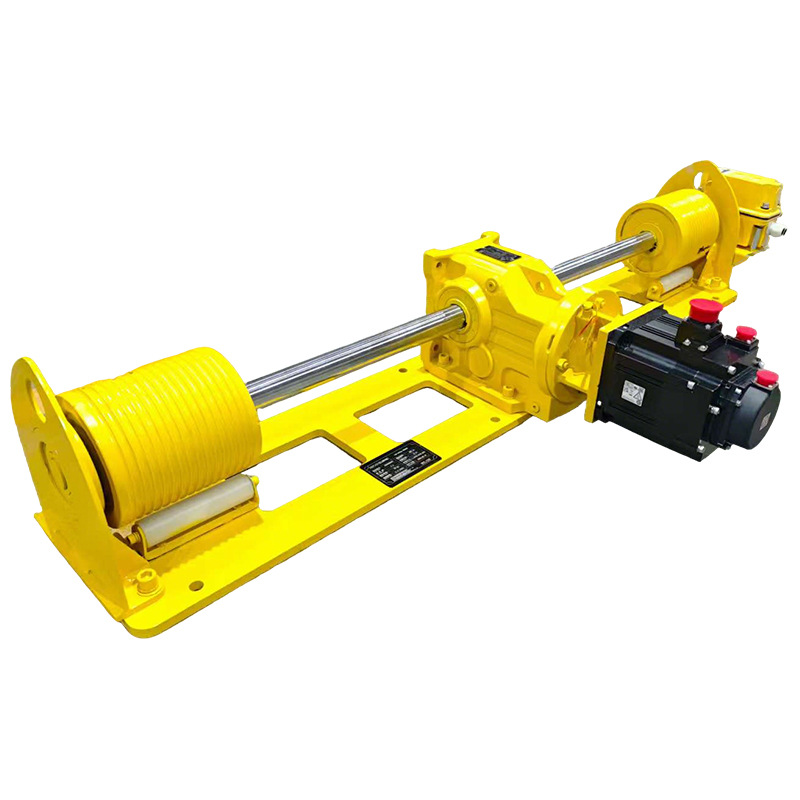
KLD provided a comprehensive solution comprising a variable frequency drive, a dual-braking system (worm gear self-locking + electromagnetic), and mechanical synchronisation of the twin drums. The equipment has now been operating stably for three months, having completed over 50 personnel hoisting operations with zero faults and zero errors, fully meeting the highest safety standards for personnel hoisting operations.
II. Issues and Pain Points
The project faced three core challenges:
1. Dual safety assurance for personnel hoisting operations
The client explicitly stated that traditional "electromagnetic brake + ratchet/hydraulic brake" solutions could not meet their safety requirements for passenger transport. Ratchet brakes cause significant impact, cannot provide dynamic protection, and lack reliable mechanical backup protection in the event of a single electromagnetic brake failure. The requirement for passenger transport is that the equipment must still be able to brake safely under any single failure mode.
2. High-precision synchronised lifting between dual suspension points
The distance between the two suspension points is 2,400 mm, and absolutely synchronised lifting and lowering is required. Theoretical calculations indicate that if the height difference between the two suspension points exceeds 50 mm, the tilt angle of the cage will reach 1.2°, which exceeds the safe and comfortable range for passengers; if the deviation exceeds 100 mm, there is a risk of overturning. Traditional dual-motor, electronically controlled synchronisation solutions suffer from response delays (typically 50–100 ms) and the risk of cumulative error.
3. Orderly arrangement of steel ropes at wide spacing
A rope spacing of 2,400 mm constitutes a relatively large span. Ensuring that the steel ropes remain neatly arranged within the rope grooves during winding and unwinding—without jumping out of the grooves or becoming tangled—whilst maintaining a precise spacing of 2,400 mm over the long term, places extremely high demands on the design and manufacturing precision of the drum. Disorganised rope arrangement will lead to increased wear and tear, shortened service life, and may even result in safety incidents.
III. Overview of the Solution
To address the above challenges, we provided an integrated solution that prioritises mechanical reliability and incorporates dual safeguards:
| Challenge | Solution | Technical Principle |
|---|---|---|
| Braking Reliability | Variable-frequency motor + worm gear reducer | Electromagnetic brake (primary) + Worm gear self-locking (secondary) |
| Dual-point Synchronisation | Single motor driving dual drums | Mechanical rigid connection: drive shaft + coupling |
| Wide-spaced Rope Arrangement | Spiral rope groove drum + centre distance positioning | Mechanical forced rope arrangement, constant spacing |
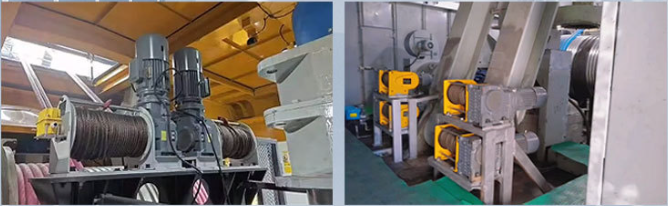
IV. Technical Specifications
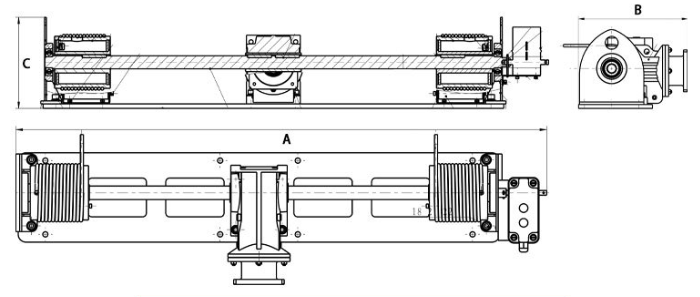
| Item | Parameter | Remarks |
|---|---|---|
| Rated pulling force | 2,000 kg | Designed for man-carrying conditions |
| Operating speed | 8 m/min | Variable-frequency stepless speed control |
| Operating stroke | 30 m | To meet on-site requirements |
| Rope spacing | 2,400 mm | Strictly guaranteed |
| Drive method | Variable-frequency motor + worm gear reducer | Worm gear reducer ratio 1:40 |
| Braking method | Electromagnetic brake (primary) + Worm gear self-locking (secondary) | Dual redundant protection |
| Drum structure | Dual-drum synchronous drive, helical rope grooves | Groove depth 12 mm |
| Control method | Variable frequency speed control | Smooth start-up and stopping |
| Protection rating | IP54 | Suitable for outdoor conditions |
V. Design Highlights
✔ Structural Design: Integrated dual-drum frame
Features a fully welded frame for high rigidity and minimal deformation. The mounting surfaces of the two drum bearing housings are machined in a single clamping operation, ensuring coaxiality ≤0.05mm and guaranteeing synchronisation accuracy from the manufacturing stage.
✔ Drive System: Variable frequency drive + worm gear reducer
The variable-frequency motor enables stepless speed control from 0 to 8 m/min, ensuring smooth starts and stops without impact. The worm gear reducer, with a gear ratio of 1:40, provides sufficient torque whilst utilising its self-locking characteristic to achieve a two-stage braking system.
✔ Braking System: Dual Redundancy Design
Primary Braking: The variable-frequency motor is equipped with an electromagnetic brake, with a response time ≤0.2 s, used for normal stopping.
Secondary braking: The worm gear's reverse self-locking mechanism operates silently and without impact, serving as a fail-safe protection. The two braking stages operate independently without interfering with one another.
✔ Synchronisation system: Mechanical hard connection
A single drive shaft and two precision couplings are used to transmit power from a single gearbox to both drums simultaneously. Universal joints at both ends of the drive shaft compensate for installation errors, ensuring smooth power transmission. The rotational speeds of the two drums are identical, achieving absolute synchronisation at the physical level.
✔ Rope Guidance System: Forced guidance via helical grooves
Helical grooves are machined into the drum surface, with a pitch matched to the wire rope diameter. The groove depth of 12 mm ensures the wire rope always runs within the groove, preventing it from jumping out or becoming tangled. The centre-to-centre distance between the two drums is strictly designed to be 2,400 mm, maintaining a constant spacing between the wire rope exit points over the long term.
✔ Control System: Variable Frequency Speed Control + Limit Switch Protection
Equipped with a variable frequency drive to ensure smooth start-up and stopping, reducing mechanical impact. Multiple safety features, including upper and lower limit switches and overspeed protection, are incorporated to ensure operational safety.
VI. Application Scenarios
This solution is suitable for the following high-demand scenarios:
- High-altitude power maintenance: Maintenance of equipment at height, such as substations and transmission towers
- Personnel lifting platforms: Vertical transport of personnel for construction work, bridge inspection, etc.
- Dual-point synchronised lifting: Lifting of long materials and large components using two lifting points
- Long-span towing operations: Dual-point towing and positioning of large equipment
- Operating conditions with high safety requirements: Sites with strict safety standards, such as nuclear power and chemical plants
VII. Project Outcomes
Following delivery of the solution, the client conducted comprehensive testing and put it into operational use:
Test Data:
| Test Item | Test Method | Test Result |
|---|---|---|
| Power failure test | Sudden power cut during normal operation | The cage stopped mid-air; no slippage |
| Simulated brake failure | Manual disengagement of the electromagnetic brake | The cage remained suspended; the second safety lock engaged |
| Synchronisation Accuracy | Measured height difference after 10 round trips | ≤2mm, imperceptible to the naked eye |
| Rope Guidance Stability | Inspected rope grooves after 50 consecutive operations | Wire rope remained within the grooves; no rope jumping out |
Operational Performance:
✅ Continuous operation for 3 months, completing over 50 passenger lifting operations with zero faults
✅ Client feedback: simple operation, smooth running, and easy maintenance
✅ Fully complies with the highest safety standards for personnel transport
Client's comment: "We'd trust this equipment enough to ride in it ourselves."
VIII. Customisation Enquiries
Company: Beijing Tianheng Kairui Industrial Equipment Co., Ltd. (KLD Winch)
Website: https://kldwinch.com
Customisation Services: We provide one-to-one technical solutions and bespoke quotations; please feel free to discuss your specific requirements
Core Strengths: serving multiple industries including power, marine and mining, and providing one-stop technical support from design to delivery.
IX. FAQ
Q1: Can the winch be customised for man-carrying applications?
A1: Yes. We offer multiple safety enhancement solutions for man-carrying scenarios, including worm gear self-locking, dual braking and redundant design. For man-carrying applications, we will increase the safety factor based on the standard design and provide a third-party safety inspection report.
Q2: What is the synchronisation accuracy of the dual-drum system?
A2: We employ a mechanical hard-connection solution, where synchronisation accuracy is guaranteed by the mechanical structure. The error can be controlled within 0.1°, corresponding to a height difference of ≤2mm between the two lifting points in this example. This is significantly higher than that of electronically controlled synchronisation solutions (which typically have an error of 5–10mm).
Q3: What is the maximum pulling force achievable?
A3: In this case, it is 2,000 kg. The KLD series winches offer a single-unit pulling force range of 0.5 t to 50 t, with higher tonnages available via custom design. The dual-drum synchronous solution can achieve a maximum of 2 × 20 t.
Q4: Does it support variable frequency speed control?
A4: Yes. This case study utilises a variable frequency motor, enabling stepless speed control from 0–8 m/min to meet requirements for smooth start-up and stopping. PLC control can also be configured as required to achieve multi-speed operation and automatic running functions.
Q5: In which environments is the equipment suitable for use?
A5: This solution has an IP54 protection rating and is suitable for outdoor, power and general industrial environments. For special environments such as those with high humidity, dust or corrosive gases, the protection rating can be upgraded to IP65 or special surface treatments can be applied.
Q6: Does KLD provide on-site technical support?
A6: Yes, we provide full-process technical support, from solution consultation and drawing confirmation to on-site commissioning. Upon delivery of the equipment, we can dispatch engineers to provide on-site guidance for installation and commissioning, as well as operational training.