

How KLD Solved the Multi-Point Lifting Challenge in High-Rise Building Demolition
As high-rise buildings continue to increase worldwide,
traditional demolition methods are gradually being replaced by:
- Intelligent demolition robots
- Automated lifting platforms
- PLC synchronized lifting systems
Compared with conventional demolition operations, intelligent demolition systems provide:
- Higher safety
- Better construction efficiency
- Lower high-altitude labor risks
- More precise operational control
However, behind every intelligent demolition robot, there is a critical system many people overlook:
The synchronized lifting winch system.
Especially in multi-point lifting applications,
the biggest challenge is not simply “lifting heavy loads”.
The real difficulty lies in:
Keeping multiple winches running synchronously for long periods under dynamic load conditions.
This project is a typical example.
Project Background
KLD was commissioned to design a synchronized lifting solution for an intelligent demolition robot platform used by a major construction contractor.
The project required:
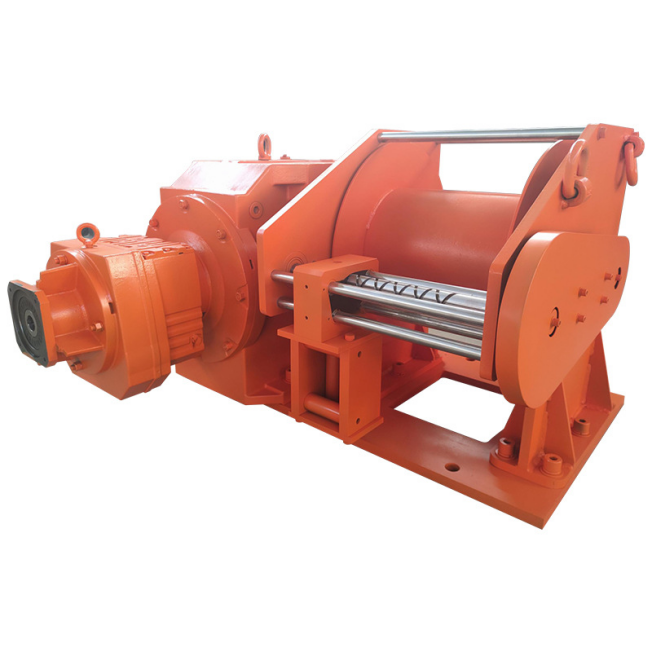
- Four 10-ton servo winches
- PLC centralized control
- Multi-axis synchronization
- Real-time correction capability
- Continuous heavy-duty operation
The lifting system would support a demolition robot platform operating at high elevation during building dismantling work.
Because the platform structure spans multiple lifting points,
even small speed deviations between winches could lead to:
- Platform tilting
- Structural stress imbalance
- Rail jamming
- Unsafe operating conditions
For this reason, synchronization accuracy became the core technical challenge of the entire project.
Why Standard Winches Cannot Handle This Application
Many customers initially assume:
“It’s just a lifting system.”
In reality, this is a highly integrated industrial automation project.
Conventional winches typically face several limitations:
1. Speed Deviation Between Units
Even if multiple standard winches use identical motors and reducers, actual operating speeds can vary because of:
- Load changes
- Motor response differences
- Rope tension variation
- Mechanical inertia
Over time, these small deviations accumulate and cause platform instability.
2. No Real-Time Synchronization Logic
Traditional winches usually operate independently.
They cannot:
- Communicate with other lifting points
- Detect platform inclination
- Automatically correct speed errors
- Adjust dynamically during operation
In high-rise demolition applications, this creates significant operational risks.
3. Slow Dynamic Response
Synchronization systems require extremely fast response speeds.
When deviations occur, the system must react immediately.
Standard frequency-conversion systems often cannot provide:
- High-speed correction
- Precise positioning
- Stable multi-axis coordination
This is why servo control technology was selected for this project.
KLD Solution: PLC Servo Synchronous Winch System
To meet the project requirements,
KLD developed a complete PLC servo-linked winch solution.
The system was designed not simply as “four winches,”
but as:
A fully integrated synchronized lifting control system.
Core System Configuration and Parameters
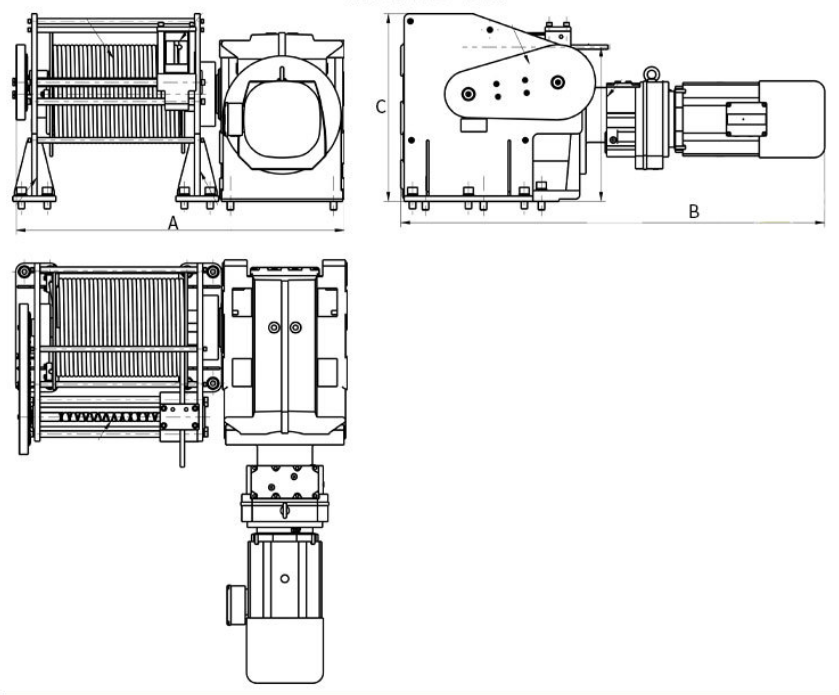
| Model | Reducer Gear Ratio | Reducer Output Speed | Output Torque | Rope Speed | Lifting Capacity | Weight | Motor Power | Wire Rope Diameter | |||
| 8000 KG | 250:1 | 5.9 rpm | 26742 N·m | 0.8-8 m/min | 10000 kg | 2200 KG | 18.5 KW | 20 mm | |||
| Model | A (Length) | B (Width) | C (Height) | ||||||||
| 8000 KG | 1527 mm | 1973 mm | 875 mm | ||||||||
1. Industrial Servo Drive System
The project adopted industrial-grade servo motors instead of traditional variable-frequency drives.
Compared with conventional systems, servo drives provide:
- Higher synchronization precision
- Faster response speed
- Better positioning accuracy
- More stable speed control
This is especially important for multi-point lifting platforms.
2. PLC Centralized Control
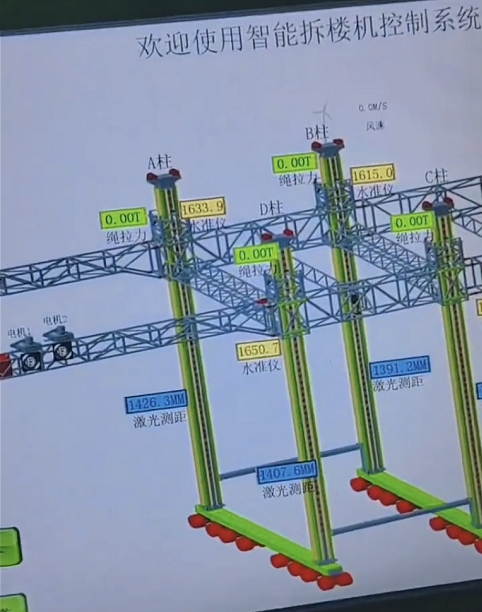
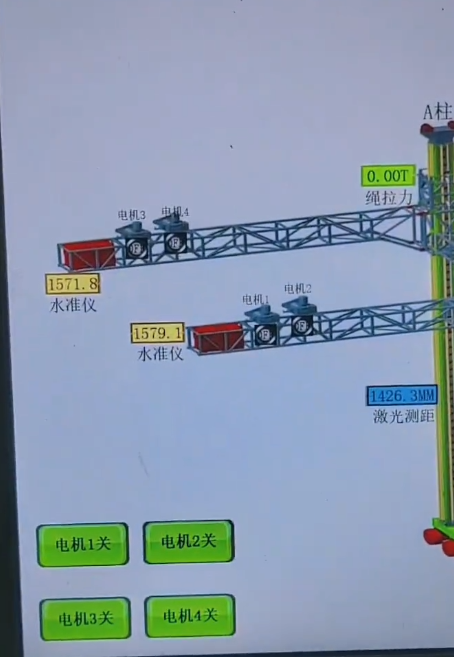
The entire lifting system is controlled by a PLC programming platform.
Functions include:
- Multi-winch synchronous operation
- Automatic lifting coordination
- Real-time data feedback
- Automatic deviation correction
- Dynamic motion adjustment
The control interface displays:
- Platform elevation data
- Laser distance measurements
- Platform leveling status
- Rope tension conditions
- Motor operating status
This allows operators to monitor the entire system visually in real time.
3. Laser Measurement + Level Detection System
One of the most important parts of the system is the real-time detection module.
The platform is equipped with:
- Laser distance measurement
- Inclination monitoring
- Real-time feedback sensors
The PLC system continuously analyzes the data and automatically adjusts the speed of each winch.
This enables true synchronized lifting control.
4. Heavy-Duty Automatic Rope Spooling System
Continuous rope winding operations often cause:
- Rope disorder
- Rope overlap
- Rope crushing
- Accelerated wire rope wear
To solve this issue,
KLD equipped the system with a heavy-duty automatic rope spooling mechanism.
Advantages include:
- Smooth rope arrangement
- Reduced rope wear
- Longer service life
- Improved operational reliability
This is critical for long-duration industrial applications.
5. Hardened Gear Reducer System
Demolition lifting systems operate under:
- Dynamic loading
- Frequent starts and stops
- Continuous heavy-duty conditions
Therefore, the project adopted industrial hardened gear reducers featuring:
- High load capacity
- Strong impact resistance
- Long operational life
- Stable continuous performance
Suitable for demanding industrial environments.
On-Site Operating Performance
During project operation,
the system successfully achieved:
- Precise four-point synchronized lifting
- Stable platform leveling
- Real-time deviation correction
- Continuous heavy-load operation
The PLC system continuously monitored:
- Platform height
- Laser measurement data
- Tension variation
- Platform leveling conditions
Compared with traditional demolition methods,
the solution significantly improved:
- Construction safety
- Automation level
- Synchronization accuracy
- High-altitude operational efficiency
At the same time, it reduced:
- Manual operation risks
- Platform tilt risks
- Human operational error
The Real Value Behind This Project
Many people see only:
“Four winches.”
But the real value of this project lies in:
Industrial automation integration capability.
The winch industry is evolving from:
- Standalone mechanical equipment
toward:
- Intelligent synchronized control systems
Future industrial winch applications will increasingly involve:
- PLC automation
- Servo synchronization
- Multi-axis linkage control
- Automatic correction systems
- Intelligent construction platforms
This trend is becoming especially important in:
- Intelligent demolition robots
- Heavy synchronized lifting systems
- Automated construction equipment
- Large steel structure lifting
- Multi-point synchronized hoisting applications
KLD Customized Industrial Winch Solutions
KLD specializes in customized industrial winch systems and supports:
- PLC programming control
- Servo synchronization systems
- Constant tension control
- Multi-winch linkage
- Automatic rope spooling
- Tension monitoring
- Laser measurement integration
- Non-standard automation system design
We also support:
- Custom engineering drawings
- 2D / 3D design solutions
- Electrical control logic development
- Complete system integration
With factory-direct manufacturing advantages,
KLD provides one-to-one technical consultation and customized engineering solutions based on actual project requirements.
Conclusion
For modern industrial lifting applications,
the key challenge is no longer:
“Can the winch lift the load?”
The real challenge is:
“Can the entire system operate safely, accurately, and synchronously over long periods?”
This project demonstrates how PLC servo synchronized winch systems are becoming the future direction of advanced industrial lifting technology.
FAQ
What is a PLC synchronized winch system?
A PLC synchronized winch system uses programmable logic control to coordinate multiple winches operating simultaneously with high precision.
Why are servo winches used in synchronized lifting applications?
Servo winches provide faster response speed, higher positioning accuracy, and better synchronization stability than standard variable-frequency systems.
What are the risks of unsynchronized lifting systems?
Unsynchronized lifting can cause platform tilting, structural stress imbalance, rail jamming, and safety hazards.
What industries use synchronized servo winch systems?
Applications include intelligent demolition robots, heavy lifting platforms, steel structure lifting, automated construction systems, and industrial automation projects.
Can KLD provide customized synchronized winch solutions?
Yes. KLD supports customized PLC control systems, servo synchronization, automatic rope spooling, tension control, and complete industrial automation integration solutions.