Application Solution for Servo Motor Cable Reels in Mobile Power Supply Systems for Robots
I. Project Background

With the continuous advancement of industrial automation technology, an increasing number of devices are adopting mobile robots or rail-mounted mobile equipment to perform tasks such as inspection, testing, and transportation. In these application scenarios, equipment typically requires sustained movement over extended distances while maintaining a stable and reliable power supply.
Traditional power supply methods primarily include drag chain power supply, conductor rail power supply, or manual cable deployment. However, under conditions of long-distance movement, complex operating environments, or frequent back-and-forth operations, these methods often encounter the following issues:
- Severe wear caused by cables dragging on the ground
- Equipment malfunctions due to cable entanglement
- Inaccurate control over cable length
- Unstable cable tension
Particularly in automated robotic systems, improper power cable management not only compromises operational stability but can also lead to cable damage or even system shutdowns.
Therefore, in modern automation equipment engineering, an increasing number of projects are adopting cable reel systems for automated cable management to achieve stable and secure mobile power supply.
II. Core Technical Requirements
For this project, the client requires a cable retrieval system for a mobile robotic device, with the following primary technical specifications:
1. Dual Functionality for Power Supply and Traction
The robotic equipment receives power via a composite cable, which must also possess sufficient mechanical strength. Consequently, the winch must provide stable traction force while ensuring the cable remains secure and reliable during operation.
2. Precise Control of Cable Retraction Length
During robot operation, the cable length must synchronize with the equipment's movement distance. The system requires cable length detection and precise control capabilities to prevent situations where the cable is excessively long or overly taut.
3. Maintain Stable Cable Tension
Excessive tension increases operational resistance, while insufficient tension causes cable dragging. The system must maintain constant tension control to ensure optimal cable stress conditions.
4. Coordinate with Robotic Systems
The client requires the winch system to synchronize with robotic equipment via PLC control, automatically performing cable deployment and retrieval during device movement.
III. Recommended Solution
Addressing these requirements, KLD designed a servo motor-driven cable winch system for the client.

This system employs a servo motor + planetary gear reducer drive structure, equipped with an automatic cable arrangement mechanism, rotating slip ring, meter encoder, and tension sensor, achieving intelligent control via PLC.
Key system components include:
- Servo motor drive system
- Planetary gear reducer
- Cable drum
- Automatic cable arrangement device
- Rotary slip ring power supply system
- Metering encoder
- Tension sensor
This system enables the following functions:
- Automatic cable payout
- Automatic cable retrieval
- Precise cable length control
- Constant tension operation mode
- Cooperative operation with robotic systems
Effectively addressing power management challenges for mobile equipment.
IV. Key Technical Parameters

| Parameter | Specification |
|---|---|
| Rated Pulling Force | 150 kg |
| Drive Type | Servo motor driven |
| Reduction Mechanism | Planetary gearbox |
| Control System | PLC control |
| Max. Cable Pay-out Speed | 10 m/min |
| Cable Type | Composite cable |
| Cable Diameter | 8 mm |
| Max. Cable Length | 100 m |
| Cable Guiding | Automatic level wind mechanism |
| Length Measurement | Rotary encoder |
| Tension Control | Load cell / tension sensor |
| Power Supply Method | Slip ring assembly |
V. Design Highlights
1. Precise Servo Motor Drive
The system employs servo motors to drive the winch mechanism, delivering high control accuracy and rapid response. It dynamically adjusts winch speed based on real-time robot operation status.
2. Automatic Cable Laying Mechanism
The winch incorporates an automatic cable lay-up device that ensures cables are neatly arranged on the drum. This prevents tangling, overlapping, and other issues, significantly extending cable lifespan.

3. Rotating Slip Ring Power Supply
A rotating slip ring system, configured according to the composite cable model, ensures stable power supply during cable retraction and extension while preventing cable twisting.
4. Constant Tension Control System
The system achieves constant tension mode through tension sensors and PLC control algorithms, maintaining optimal cable tension during retraction and extension to prevent dragging or excessive stretching.
5. Precise Cable Length Control
The winch incorporates a meter-counting encoder for real-time detection of cable retraction/extension length, enabling accurate control.
VI. Applicable Scenarios
This servo motor cable winch system is widely used in the following fields:
- Industrial inspection robots
- Rail-based robotic systems
- Automated production equipment
- Port automation equipment
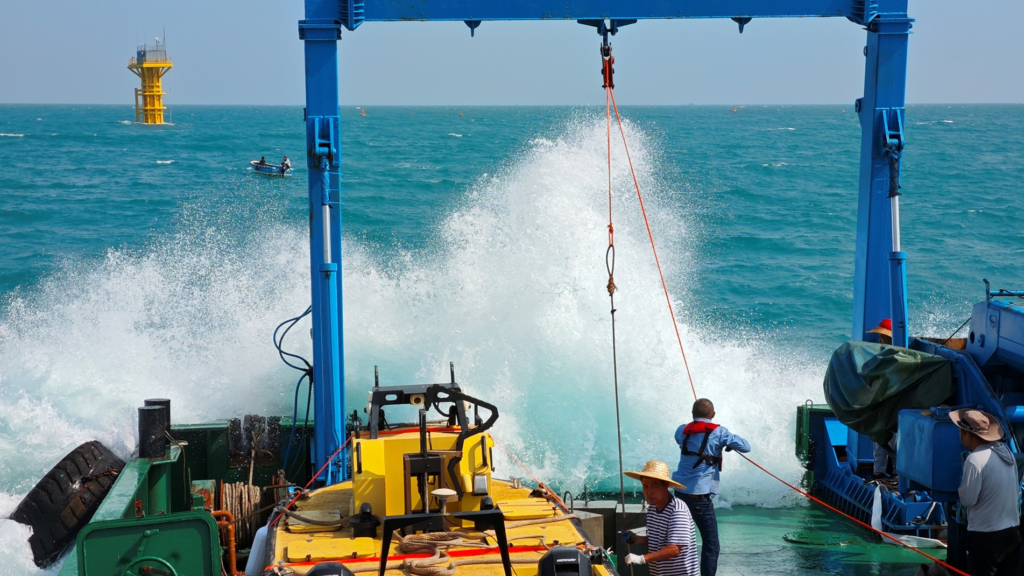
- Underwater robot testing equipment
- Industrial mobile equipment power supply systems
This system demonstrates excellent reliability and adaptability in applications requiring automatic cable retraction while maintaining stable power supply.
VII. Project Value and Summary
By adopting a servo motor-driven cable winch system, this project successfully resolves cable management issues during mobile power supply for robotic equipment, achieving the following outcomes:
- Enhanced equipment operational stability
- Prevention of cable dragging and entanglement
- Improved automation control levels
- Reduced equipment maintenance costs
This solution provides a reliable and efficient power management method for mobile robotic equipment, offering broad application prospects in the automation field.
FAQ (Frequently Asked Questions)
Q1: What equipment primarily uses cable reels?
Cable reels are mainly used for automated equipment requiring mobile power supply, such as inspection robots, rail-mounted robots, and automated production equipment.
Q2: What advantages do servo motor reels offer over conventional reels?
Servo motor winches offer high control precision, rapid response times, and PLC-coordinated control capabilities, making them highly suitable for automation applications.
Q3: Can cable winches be customized?
Yes, parameters such as pulling force, drum capacity, cable length, control methods, and mounting structures can be tailored to customer requirements.
Q4: Does KLD support customization?
Yes, winch systems can be customized according to specific operational conditions.