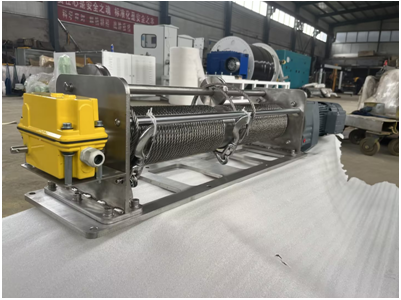
Application Scenarios of Integrated Equipment Winches: Warehousing, Production Lines & Long-Travel Traction Solutions
In industrial systems, a winch is far more than something that “just pulls or lifts.”
When it becomes an integrated execution component in warehousing, production lines, ports, and mining systems, the degree of matching directly determines reliability and cycle efficiency.
Below, we break down the high-frequency scenarios:
Where the winch is used, why problems easily occur, and how to configure it for stability.

Scenario 1: Warehousing & Logistics / ASRS Shuttle and Handling Systems
Typical Tasks
- Reciprocating traction of boxes/pallets inside aisles
- Positioning of rail-guided shuttles and transfer tables
- Tensioning and retrieval in automatic sorting sections
Common Pain Points
- Speed instability causes cycle-time fluctuations
- Short-stroke high-frequency operation leads to rope disorder
- Insufficient positioning accuracy affects sensors/robot actions
Key Matching Solutions
- VFD speed control for smooth start/stop
- Automatic rope spooling/guide system to avoid rope disorder

- Limit switches or closed-loop limit control to ensure repeatable positioning
- Compact structure for aisle or internal equipment mounting
Scenario 2: Production Line Traction / Workstation Transfer Carts
Typical Tasks
- Pulling heavy tooling fixtures between workstations
- Traction of molds, racks, or jig carts
- Reciprocating traction on coating/heat-treatment/assembly lines
Common Pain Points
- Frequent start-stop cycles cause motor overheating
- Sudden starting impact leads to rope shock and structural fatigue
- Speed mismatch slows down workstation cycle time
Key Matching Solutions
- Select duty cycle based on cycle count and peak load
- VFD soft-start/soft-stop to reduce impact
- Brake sizing based on inertia for safer emergency stops
- Optional dual drums for long-stroke or bi-directional high-frequency use
Scenario 3: Shipyard/Port Hose, Cable, or Long-Travel Traction Systems
Typical Tasks
- Long-distance deployment and retrieval
- Heavy-duty pulling of hoses/cables
- Slow-speed traction, positioning, and tensioning for port equipment
Common Pain Points
- Long travel requires large drum capacity and proper rope spooling
- Stable tension control is essential during retrieval
- Severe corrosion in marine/outdoor environments
Key Matching Solutions
- Large-capacity drum design for long-travel applications
- VFD control to maintain stable speed and tension
- Corrosion-resistant materials and upgraded coating systems
- Multi-rope or guided rope structures to ensure alignment under wide loads
Scenario 4: Large Frame Synchronous Traction / Lifting
Typical Tasks
- Synchronous movement of wide platforms or large frames
- Multi-point lifting requiring level accuracy
- Equipment assembly positioning without tilting
Pain Points
- Speed differences between points cause frame deviation
- Uneven force distribution affects safety
- Synchronous control logic is complex
Key Matching Solutions
- Multi-rope synchronized PLC/VFD linkage
- Tension and displacement feedback for balanced control
- Brake and gearbox sizing based on load distribution
How to Quickly Get a Matching Winch Solution
Provide the following parameters, and the configuration can be determined efficiently:
- Load and motion task
- Travel distance, speed, and cycle time
- Duty cycle (cycles per hour, run/idle ratio)
- Rope path & pulleys (if mechanical advantage applies)
- Control method (manual / VFD / PLC / synchronized control)
- Site environment (corrosion, dust, explosion-proof, etc.)
- Installation space & constraints
Just tell us:
“Which system it’s used in, how heavy it pulls/lifts, how far it travels, how fast it needs to run, and how many cycles per day.”
We will deliver:
- A matched configuration for your scenario
- Size and installation recommendations
- Electrical control integration plan
- Multi-scheme quotation comparison