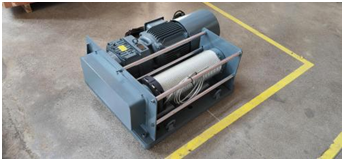
Applications of Industrial Electric Winches in Warehousing and Production Line Towing:Compact Structure + Automatic Rope Spooling + Integrated Control
Why Are More Engineers Choosing Industrial Electric Winches?
In many factories, warehouses, and production lines, towing carts or tooling platforms is often handled “incidentally” by forklifts.
At first, this seems convenient:
- Forklifts are already available on site
- Operators are present and can help when needed
- Pulling one or two tons of tooling carts doesn’t seem difficult
However, over time, problems start to appear:
- Forklifts are busy with loading, unloading, and internal logistics—towing tooling carts is always a low priority
- As workshops expand and workstations get farther apart, scheduling becomes chaotic and production rhythm depends on forklift availability
- In narrow aisles or near platform edges, forklifts are difficult to maneuver, creating safety risks
As a result, more engineers begin asking themselves:
“Shouldn’t we use a dedicated piece of equipment for these repetitive, fixed towing tasks?”
This is where compact, integrated industrial electric winches with automatic rope spooling and electrical control become an increasingly attractive option.

1. A Typical Scenario: 30-Meter Aisle + Tooling Carts
Imagine this working condition:
- A straight aisle of about 20–30 meters, connecting a production line with a pre-assembly or maintenance area
- Rails or guide tracks installed, with tooling carts moving back and forth
- Each towing operation involves 500–2000 kg—manual pushing is exhausting, and using a forklift feels excessive
By installing an industrial electric winch on a steel column or platform beam at one end or mid-point of the aisle:
- The winch is fixed to a column or platform edge, occupying minimal floor space
- The wire rope runs through guide pulleys and connects directly to the tooling cart
- Operators simply press a button or use a remote control to pull the cart smoothly into position
For workstations that demand stable takt time, safety, and reliability, this setup is far more practical than “waiting for a free forklift.”
2. What Problems Does an Industrial Electric Winch Actually Solve?
Compared with temporary or improvised solutions (forklift towing, small construction winches, manual pushing), industrial electric winches address two fundamental challenges:
“Frequent Operations + Fixed Routes”
- Dozens or even hundreds of towing or lifting cycles per day
- Fixed paths, controlled speed, and predictable motion
“Integration into the Production Process”
- The winch becomes part of the process, not an occasional helper
- Must integrate with safety interlocks and control systems
Compact industrial electric winches typically offer:
- Small footprint and flexible installation – mountable on columns, beams, or inside equipment frames
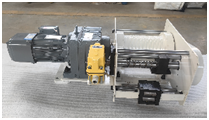
- Automatic rope spooling with grooved drums – neat wire rope arrangement, reducing overlapping, crushing, and premature failure

These characteristics make them ideal dedicated towing units for fixed workstations.
3. Why Is an Industrial Winch More Cost-Effective Than Temporary Solutions?
Many people initially feel that industrial winches are “not cheap.”
But when evaluated from safety, productivity, and service life, they often prove more economical.
1) Safety: From “It Works” to “It’s Safe for Long-Term Use”
- Automatic rope spooling and grooved drums significantly reduce rope overlap, shock loads, and jamming
- Integrated electrical control simplifies emergency stop, upper/lower limits, and safety interlocks
- Operators no longer need to stand in hazardous areas to assist manually
For high-frequency applications, predictable and controllable safety matters more than short-term cost savings.
2) Production Rhythm: No More Dependence on Forklift Availability
- The winch is always in position and ready to work
- Towing operations are independent of forklift scheduling
- Can be connected to PLC systems for synchronized production control
In simple terms:
The winch is part of the workstation—forklifts are only temporary helpers.
3) Service Life & Maintenance: Designed for Long-Term Duty
Industrial electric winches use industrial-grade motors and gear reducers, combined with proper rope spooling systems, specifically designed for high-duty cycles.
- More uniform wire rope loading and controlled wear
- Standard components that are easy to source and replace
- Fewer failures compared to light-duty winches that require frequent replacement
4. Three Common Pain Points—and How Industrial Winches Solve Them
① “The rope keeps getting tangled and has already broken several times.”
Condition:
Standard small winch with a smooth drum, frequent rope overlap.
Result:
Shock loading, rope jamming, and high safety risk.
Solution:
Use an industrial electric winch with automatic rope spooling and grooved drum, properly matched rope diameter and speed.
② “Installation space is very limited—we can only mount it on a beam or inside the frame.”
Condition:
Dense equipment layout, limited space.
Solution:
Compact, integrated industrial winch design with multiple rope exit directions, using guide pulleys to route the rope as required.
③ “We may need PLC control and interlocks later—we don’t want to redesign everything.”
Condition:
Project starts as standalone equipment but will later integrate into a production line.
Solution:
Choose a winch with standard electrical interfaces, dry contacts, and reserved control signals for future upgrades.
Clear problem definitions paired with practical technical solutions often make engineers more confident in moving forward.
5. Typical Applications for Industrial Electric Winches
Industrial electric winches are particularly well-suited for:
- Tooling cart towing and material transport in workshops or warehouses
- Transfer platforms and flipping fixtures between production line sections
- Platform lifting, maintenance trolleys, light-duty lifting and pulling
- Space-constrained installations on steel structures or equipment frames
- Projects with high requirements for safety, rhythm stability, and ease of maintenance
If your application matches these scenarios, an industrial electric winch is often a better choice than forklifts, light-duty winches, or manual handling.
6. How to Quickly Get a Winch Solution for Your Project
To avoid incorrect selection and costly rework, prepare the following before consulting a winch supplier:
- Maximum load (kg or kN) and required safety factor
- Desired speed range (m/min) and fine positioning requirements
- Daily operating time and start/stop frequency
- Site layout sketches or photos, especially rope direction and space constraints
- Control method: local buttons, remote control, PLC integration
With this information, suppliers can quickly provide:
- Preliminary winch configuration
- Wire rope and drum capacity recommendations
- Installation and rope routing suggestions
- Estimated cost range
This approach is far more efficient than simply asking, “How much does your winch cost?”
7. Summary
In modern factories and engineering projects, a winch is no longer “just a motor with a drum.”
It directly affects:
- Production rhythm stability
- On-site safety control
- Predictability of maintenance costs
When an industrial electric winch is selected as a long-term workstation component rather than a temporary tool, the value it brings often exceeds expectations.
If you are looking for a more reliable towing solution for warehousing systems, production lines, or tooling platforms, industrial electric winches may be the key to freeing forklifts and stabilizing your production rhythm.