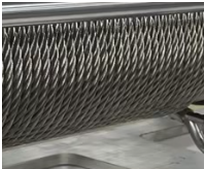
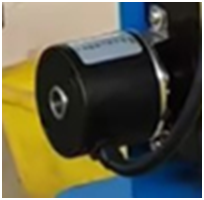
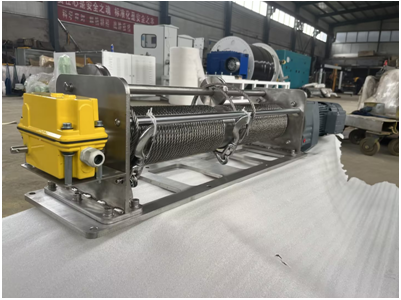
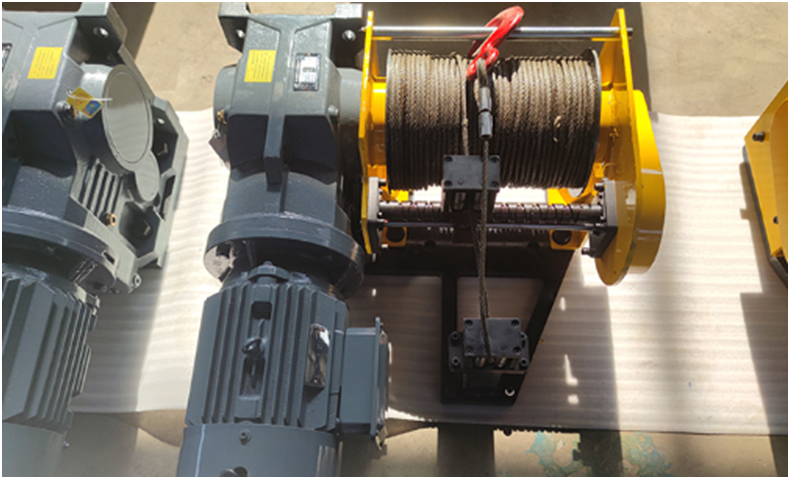
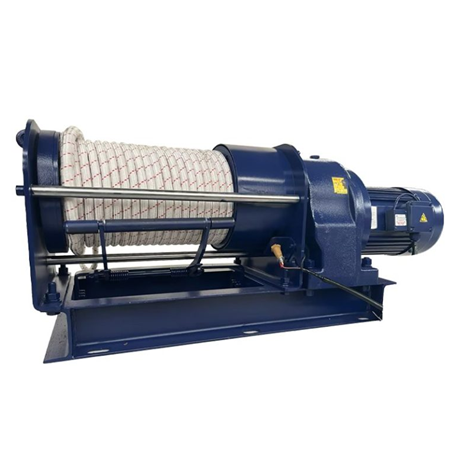
This industrial winch is designed specifically for two-point synchronized pulling/lifting and long-stroke reciprocating movements. With Equal Speed / Equal Length synchronization logic, VFD (variable frequency drive) plus encoder closed-loop control, and an optional level-wind device, it keeps the rope neatly layered and the line speed stable even in high-frequency pay-in/pay-out applications, making installation and commissioning more straightforward.
1. What problems does this winch solve?
Speed drift Long travel with large rope storage often leads to speed variation. By separating the pulling and storage functions and using VFD closed-loop control, this winch keeps the line speed consistent.
Messy rope layering Frequent rope in/out can easily cause “cross-winding” and messy layers. The level-wind/rope guide keeps the rope neatly layered and extends rope service life.
Difficult synchronization For two-point lifting or pulling, you can select Equal Speed or Equal Length logic so that both geometric displacement and cycle timing are under control.
Hard integration with existing lines With PLC/HMI/encoder, I/O interlocks, and multiple control modes (remote pendant, radio, panel), the system can be integrated smoothly into existing production lines.
Long commissioning time The compact I-frame structure and clearly marked terminals mean you can power up, jog, correct, verify interlocks and get the system into operation quickly.
2. Typical applications
Test and durability lines Constant-speed pulling plus length/speed measurement and logging to meet QA and repeatability requirements.
Long-travel positioning Reciprocating movements in the 60–300 m range, with stable layering, fewer stops and predictable cycle times.
Two-point synchronization / fixture movement Equal Speed / Equal Length logic keeps jigs and fixtures from twisting or skewing, improving positioning stability.
Outdoor / nearshore / clean environments Optional stainless-steel components, sealed bearings and IP-rated electrical cabinets provide corrosion resistance and easy cleaning.
3. Typical specification range
Pulling / lifting capacity From light loads up to multi-ton class (designed according to kN/ton and duty cycle).
Line speed Typically 8–20 m/min, adjustable up or down with configurable acceleration/deceleration curves.
Total travel From several tens to several hundred meters (rope capacity matched by rope diameter, drum and level-wind design).
Rope types Commonly Ø10–Ø16 mm wire rope or synthetic rope (synthetic rope requires appropriate de-rating and wear protection at the outlet).
Power supply Three-phase 380/400/480 V, 50/60 Hz.
Control Pendant / panel / wireless; encoder for length and speed measurement; PLC/HMI with recipes, logging and I/O.
Safety Electromagnetic / fail-safe brake, upper and lower limit switches, emergency stop, overload/overcurrent/over-temperature protection, and optional audible/visual alarms.
Not sure whether to choose Equal Speed or Equal Length? If you care more about stable cycle time, choose Equal Speed. If you care more about identical displacement at both points, choose Equal Length. If the two rope paths or pulley ratios are different, you can use Ratio synchronization.
4. Key configurations and options (combine as needed)
Rope path and layering Rope guides, level-wind device, storage modules and large-radius, wear-protected outlets.
Control stack Basic VFD speed control → VFD + encoder → PLC/HMI with recipes, logging and user permissions.
Materials and protection Carbon steel with anti-corrosion coating and/or stainless-steel components, sealed bearings, IP-rated control cabinet, low-temperature heating/dehumidification where required.
Integration and communication I/O interlocks, remote enable signals, and mapping to SCADA/MES systems.
5. Comparison with other options (for faster selection)
Double-drum winch: Can be done, but control is more complex.
Single-rope winch: Requires additional mechanisms and control logic.
Key concern: Long-travel rope layering
Dual-rope I-frame winch: More stable when equipped with level-wind.
Double-drum winch: Achievable.
Single-rope winch: Higher design complexity.
Key concern: Installation and commissioning
Dual-rope I-frame winch: Fast (compact structure, easy wiring).
Double-drum winch: Medium.
Single-rope winch: Fast.
Key concern: Adaptation cost
Dual-rope I-frame winch: Medium (balanced functionality vs. cost).
Double-drum winch: Higher.
Single-rope winch: Lowest.
6. RFQ checklist
When you send us an RFQ, please include at least:
Rated line pull (kN/ton) and duty cycle (S-class / cycles per hour).
Target line speed (m/min) and capacity margin; whether soft start/soft stop is required.
Total travel (m); rope diameter and type; whether you need level-wind and preferred rope direction.
Synchronization mode: Equal Speed / Equal Length / Ratio, and the required synchronization accuracy.
Power supply: voltage/frequency; available capacity on site and any distribution constraints.
Controls: pendant / panel / wireless; whether encoder display and PLC/HMI integration are needed.
Environment: indoor/outdoor/nearshore, cleaning frequency, temperature range and target IP rating for the electrical cabinet.
Compliance and documentation: FAT, load tests, certificates, packaging and expected delivery time.
Share the above information and we will provide a dedicated specification sheet, detailed quotation and production plan, together with rope-path and installation recommendations to help you achieve one-time installation and long-term stable operation.
7. FAQ
Q1: We want to start with pendant control and upgrade to PLC/HMI later. Is that possible? Yes. The electrical design reserves I/O points and communication interfaces, so you can upgrade later without major rewiring.
Q2: Will the load “run away” if power fails? The system uses a fail-safe brake and controlled deceleration. For back-driving loads, we calculate the required braking torque with a safety margin and can provide redundant solutions if needed.
Q3: Is a level-wind device absolutely necessary? For travel ≤20–30 m with good operating discipline, a properly designed guide can be sufficient. For long travel or high-frequency cycles, we recommend a level-wind device for more stable layering and fewer unplanned stops.
Q4: Can we use synthetic rope? Yes. We will match groove and guide design to the rope and apply a reasonable de-rating. We also recommend wear protection and larger-radius sheaves at the outlet.
Q5: How should we choose between Equal Speed and Equal Length? Choose Equal Speed when a stable cycle time is the priority. Choose Equal Length when you need both points to move the same distance. If the two rope paths have different pulley ratios, choose Ratio mode.
Q6: How can we improve durability for outdoor or nearshore applications? We recommend planning the proportion of stainless-steel parts, IP rating and coating system for the control cabinet, sealed bearings, plus low-temperature heating/dehumidification in one package. This gives the best long-term reliability.