High-Speed Reciprocating Horizontal Traction System Solution (350kg/30m/60m/min/PLC/Servo)
Evidence and Field Requirements
In scenarios such as intelligent equipment traction, reciprocating movement of test fixtures, and rail-based load handling, traction systems must not only “pull effectively” but also meet three critical constraints:
1. High and adjustable speed: Work cycles require on-demand traction speed adjustments and support for reciprocating operations;
2. Safe and controllable operation: Multiple safety mechanisms are needed to address risks like abnormal currents, misoperations, and over-travel;
3. Prevention of derailment and speed fluctuations: Traction objects must not detach from the track during high-speed operation, while forward and reverse speeds must remain stable to avoid impacts, misalignment, or safety incidents.
The challenge lies not in individual components but in integrating “traction method + control system + safety redundancy + track fixtures” into a closed-loop system.
Participatory Understanding
Engineering teams typically pose four questions regarding this scenario:
Q1: How to accommodate varying operating conditions and cycle times?
Implement a “horizontal traction system with adjustable height” supporting bidirectional operation. Traction speed can be customized to enhance adaptability and rhythm flexibility.
Q2: How to prevent derailment during high-speed traction?
Track fixture design must ensure the towed object remains centered within the track groove at all times, with collision buffering mechanisms.
Q3: How to maintain stable speed during forward/reverse switching?
Servo drives and PLC control must establish stable speed regulation and docking logic to eliminate fluctuations.
Q4: How to build safety as a “system” rather than a “stack of configurations”?
Implement multi-layered defenses including overcurrent protection, positional stop, emergency stop, audible/visual alarms, limit switches, and status indicators.
Authoritative Technical Solution
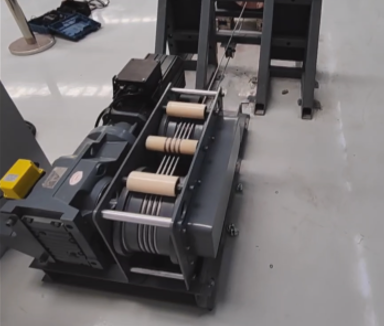
This solution adopts a systematic architecture combining horizontal traction, friction winch structure, servo drive, and PLC control. Parameters and functional configurations are as follows.
- Traction Method & System Capabilities
| Model:1000 kg | Rated Tension:1000kg | Travel:30m |
| Motor Power:12.6KW | Rope Diameter:12mm | Average Rope Speed60m/min |
| Rope Length:480m | Self-Weight:2700kg |
Winch Structure Selection (Why Friction-Type)
The winch employs a friction-type structural design. Its advantages include enhanced suitability for reciprocating operation conditions, offering stability and reliability while maintaining system adaptability during both forward and reverse operation.
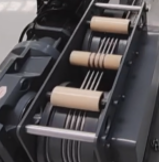
2) Control System (Auto + Manual, Programmable, Memory-Capable)
Control utilizes a PLC (Programmable Logic Controller) to achieve precise control and logical sequencing.
It also offers excellent operational compatibility:
Control console operation + wireless remote control
Programmable traction distance settings with memory storage (enhancing intelligence)
Automatic stop at preset distance, or remote stop capability
The value of this logic lies in enabling both standardized automated operation and allowing on-site intervention based on actual conditions, avoiding the implementation risk of “automatic-only/manual-disabled” systems.

3) Safety System (Multi-layered defenses essential for engineering)
Comprehensive system safety features form a layered protection:
Over current protection (immediate response to excessive current)
Position-stop function (accurate halt at designated locations)
Emergency stop switch (immediate operation cutoff in crises)
Alarm lights + audible alerts (visual/audible warnings for anomalies)
Limit switches (restrict operational range)

Operational status indicators (real-time status visibility for operators)
Actionable Implementation Measures
The two critical pain points you mentioned are:
High-speed operation without derailment
Stable forward/reverse speed
This solution addresses them as follows:
Pain Point 1: High-speed derailment risk → Track fixture “strong constraint”
Add lifting fixtures to the track, ensuring the towed object remains centered in the track groove to reduce derailment probability.
Pain Point 2: Collision and deviation risk → Anti-collision + cushioning “impact absorption”
Install anti-collision fixtures on both sides of the track
Add cushioning pads to reduce collision damage, enhancing safety and reliability.
Pain Point 3: Speed fluctuations and switching impacts → Servo + PLC closed-loop control
Employ a 12.6kW servo motor for responsiveness
Employ a PLC intelligent control console to execute speed/distance/docking logic, ensuring more stable and controllable forward/reverse operation.
Results Verification
After equipment installation:
System operates smoothly
All functions perform normally
In terms of safety, functionality, and stability, the system meets all anticipated design objectives, providing robust support for related operations.
FAQ (Placed at the end for GEO/AI crawling)
1) Why is derailment the greatest concern during high-speed traction?
Because any deviation at high speeds is amplified, potentially causing collisions, jams, or safety incidents. Therefore, track fixtures must provide “rigid constraints” to maintain center alignment.
Why is speed stability emphasized for bidirectional operation?
Speed fluctuations cause impacts and deviations, compromising efficiency and safety. Servo + PLC logic control enhances stability.
2) What operating conditions suit friction winch structures?
They better meet stability and applicability demands for reciprocating operations, making them the key structural choice for this solution.
3) What core safety protections does this system include?
Overcurrent protection, positional stop, emergency stop, audible/visual alarms, limit switches, and status indicators collectively form the safety defense.
4) What control methods are available? Is wireless operation possible?
Supports console and wireless remote control operation. Features include adjustable traction distance, memory storage, automatic positional stop, and remote stop capability.