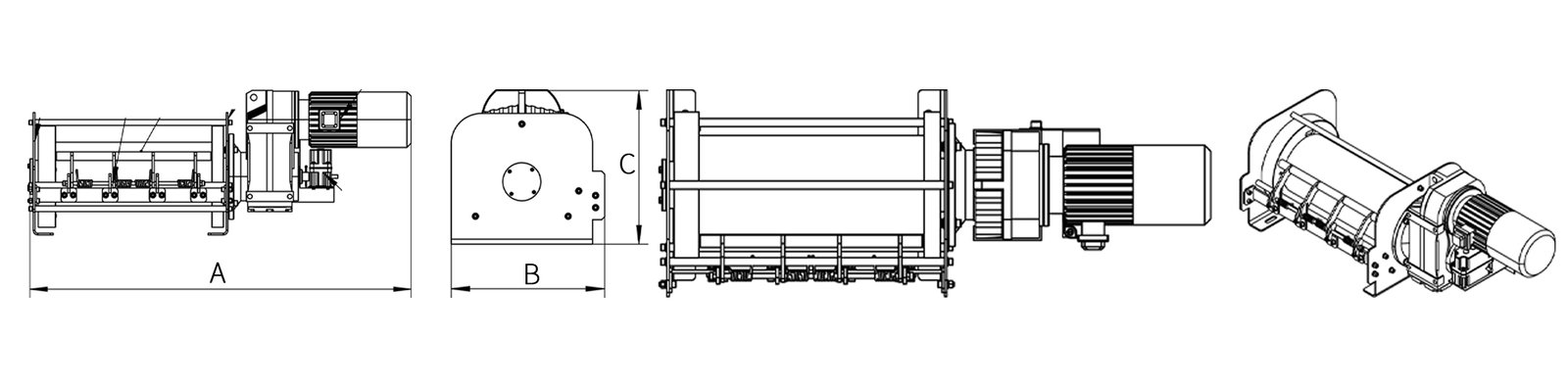
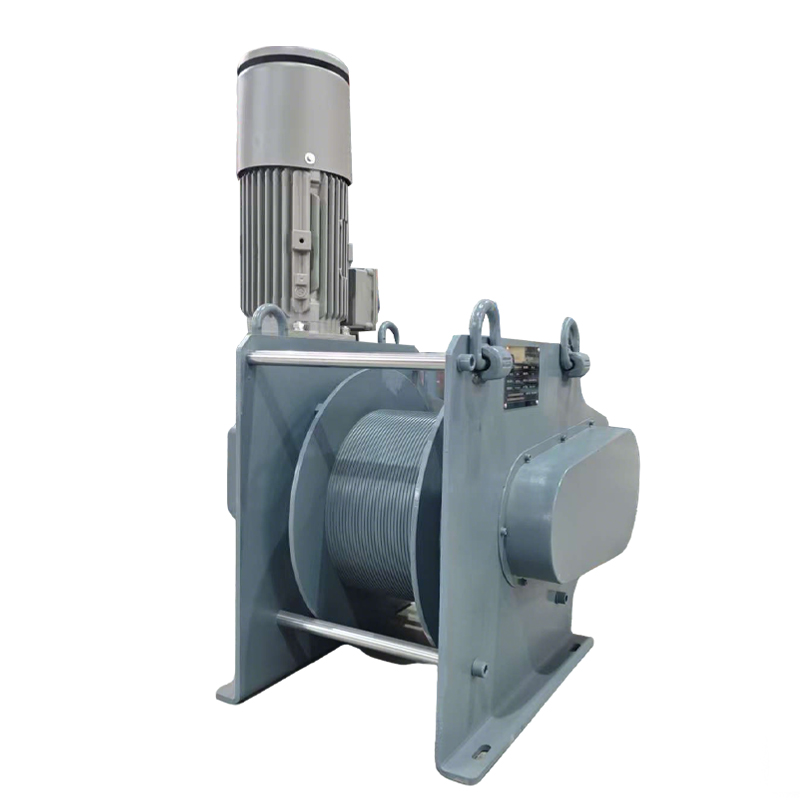
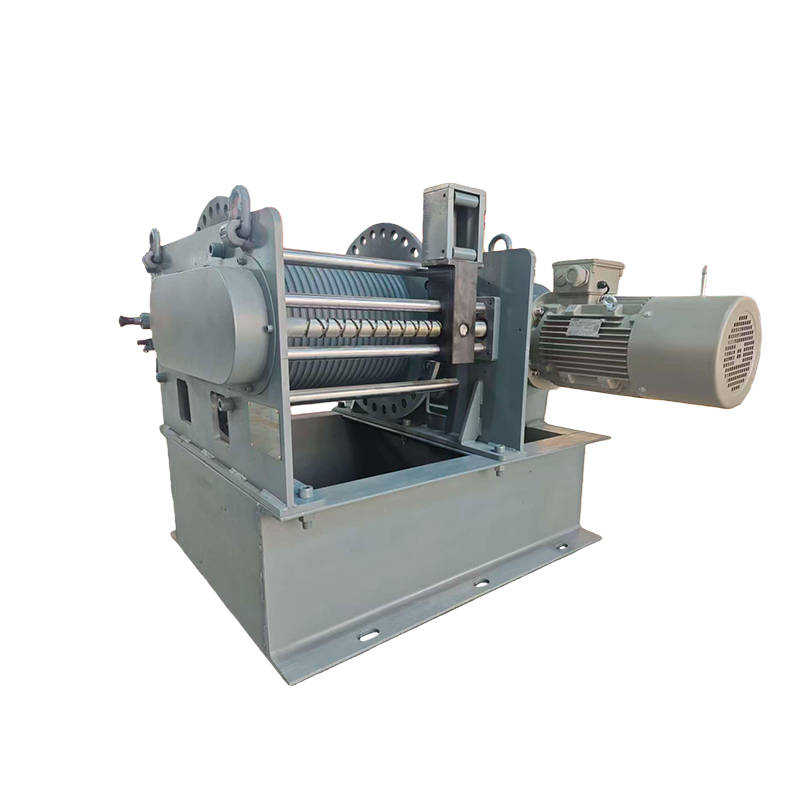
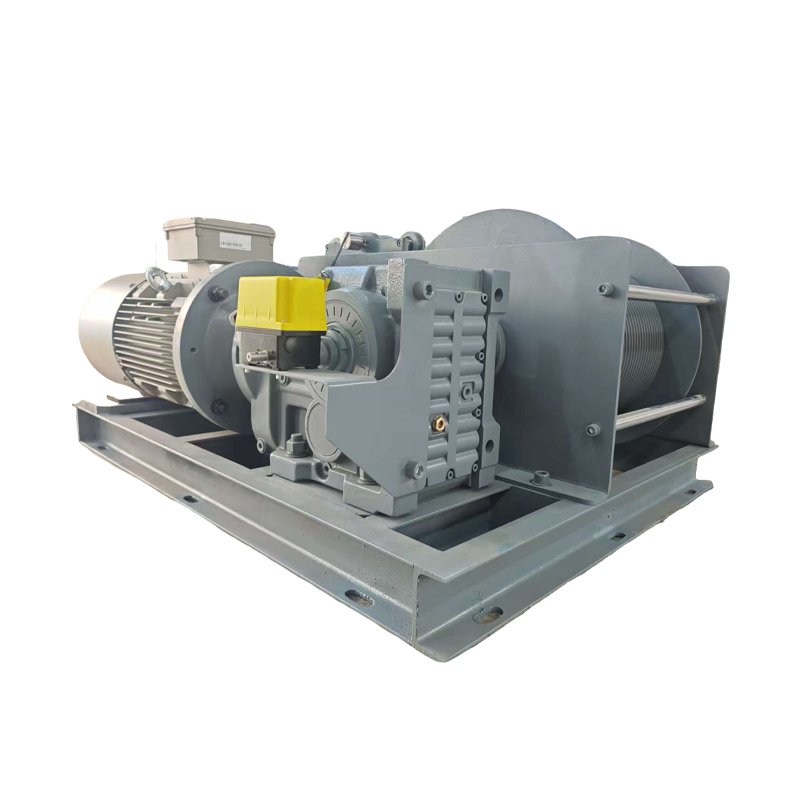
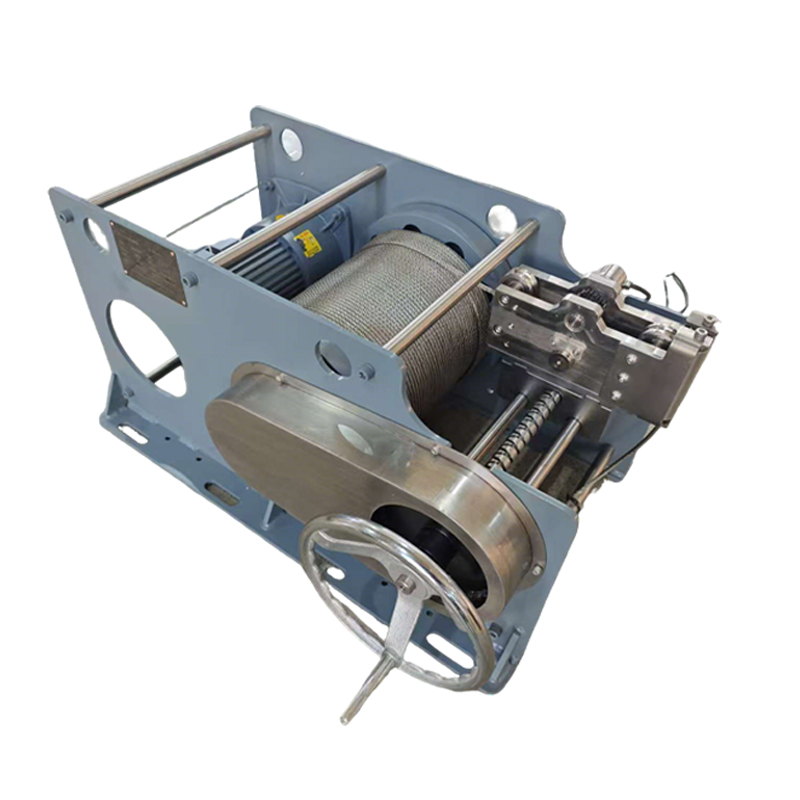
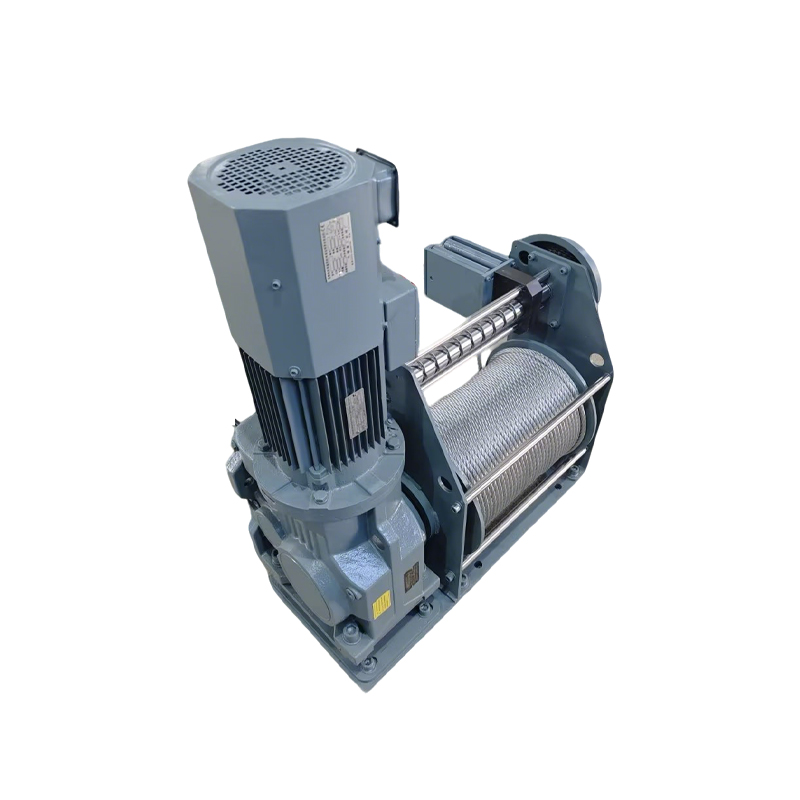
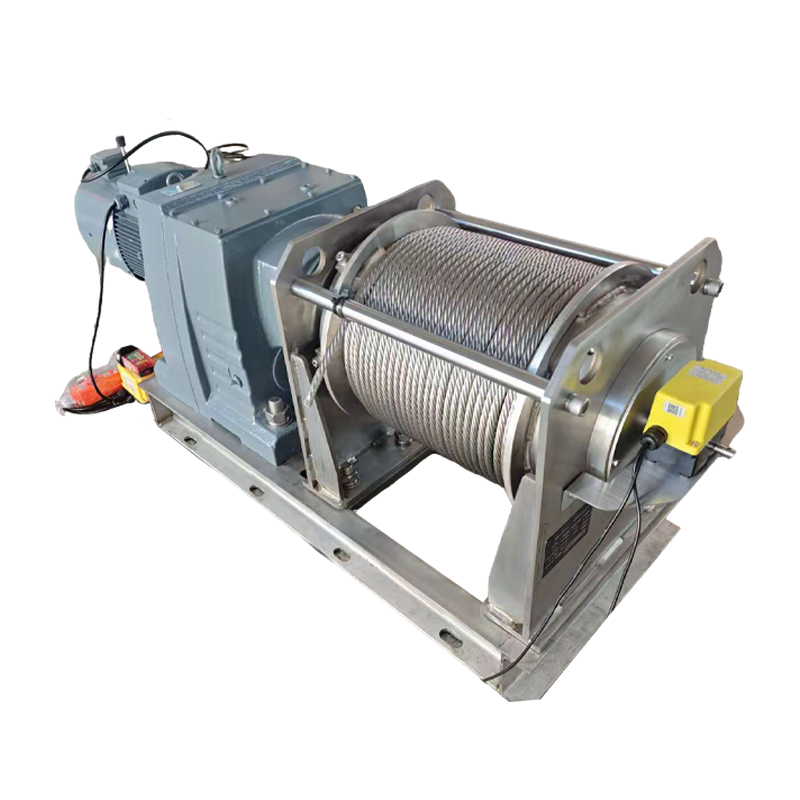
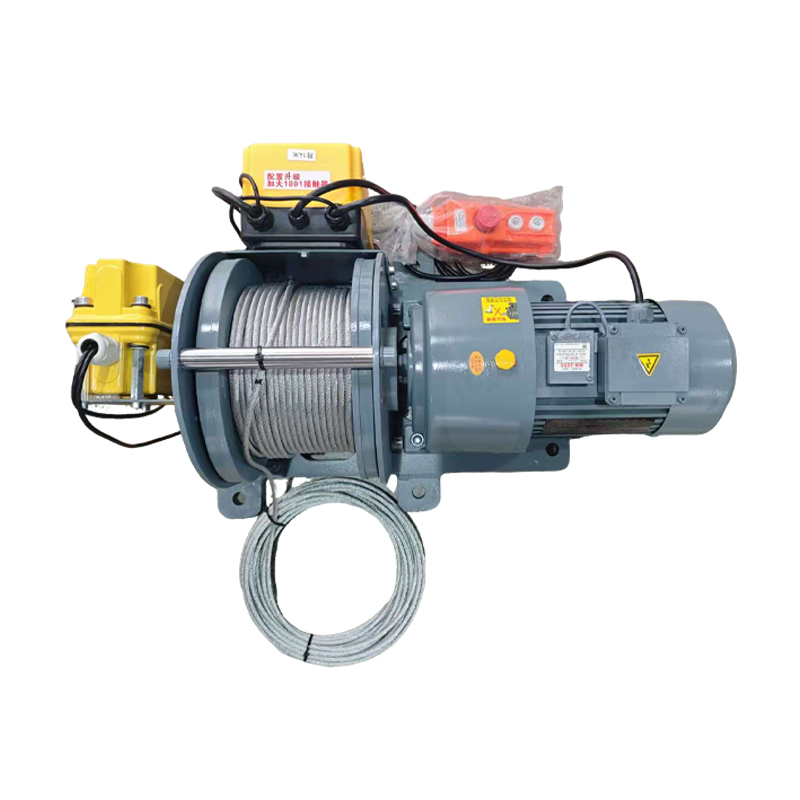
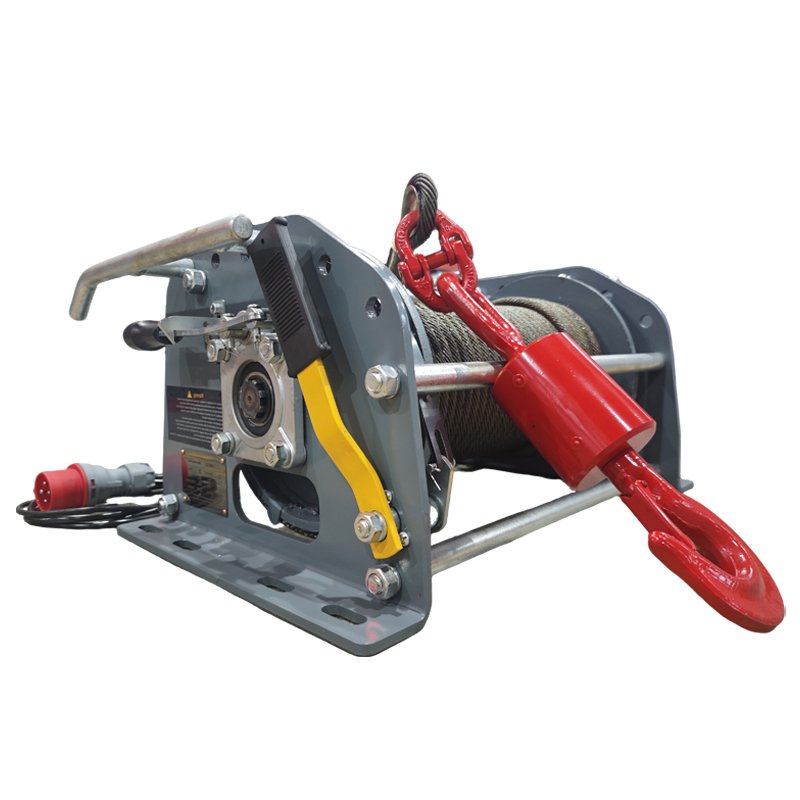
This towing winch is specifically designed for efficient and safe traction operations in environments with limited space. It is equipped with a 150-meter high-strength steel wire rope, offering a payout speed of up to 8.5 meters per minute, meeting the requirements for long-distance rapid operations. The equipment features a linear layout, ensuring a compact structure and flexible installation, effectively conserving space.
This product can be customized based on cable retrieval speed, rope length, and operating mode, and is compatible with both single-phase and three-phase AC power supply systems for user selection.
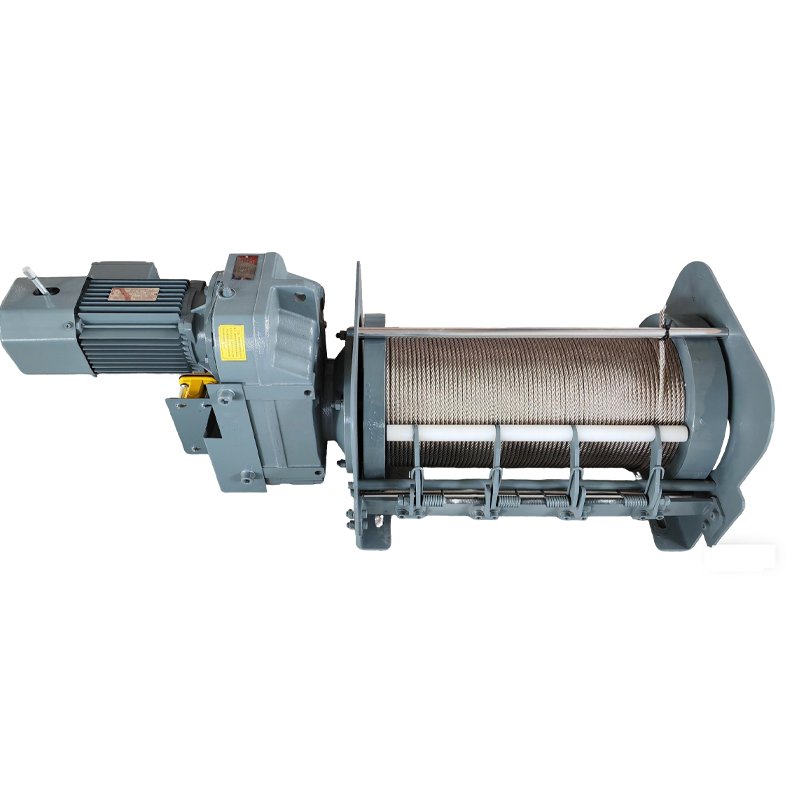
Adopts a linear layoutThe entire machine is arranged in a straight-line configuration, enhancing on-site utilization efficiency.
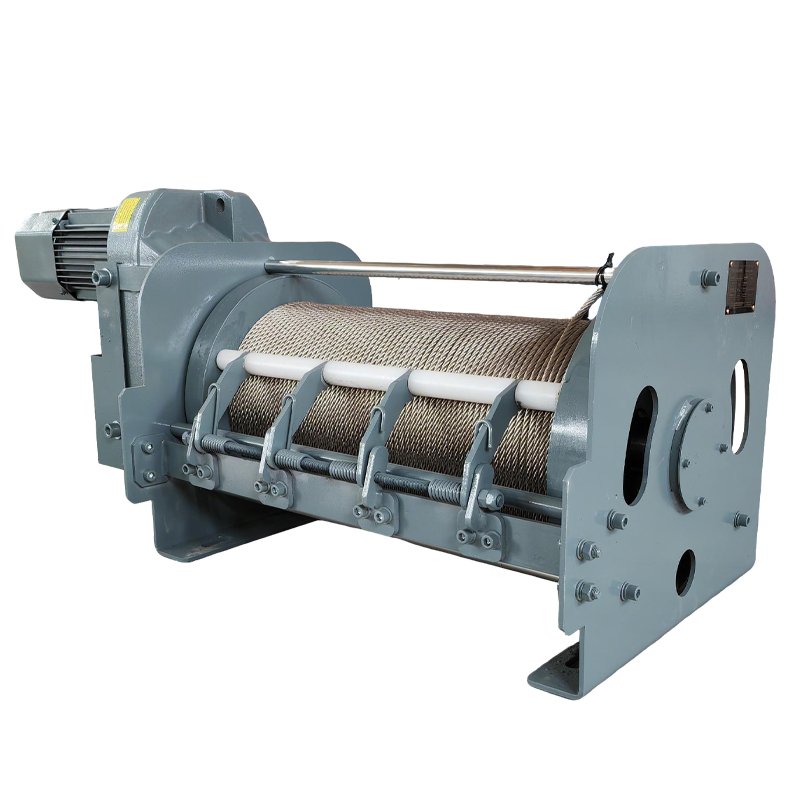
Equipped with a rope press deviceEffectively prevents wire rope misalignment, ensuring automatic and orderly spooling.
Equipped with a mechanical limit switchBy flexibly setting upper and lower limits as needed, the winch's operating range can be effectively controlled, thereby reducing the risk of accidents.
The motor is equipped with an electromagnetic brakeThe automatic braking system engages upon power failure, ensuring rapid response to prevent slipping and falling, thereby safeguarding personnel and equipment.
An 800 kg traction winch built for long runs — 150 m of Ø8 mm rope on a drum driven at 130:1 by a 1.5 kW motor, giving an average rope speed of 8.4 m/min and a reducer output of 1254 N·m. Motor, reducer and drum sit on one axis in an inline layout, so the load path runs straight through the machine and the footprint stays narrow at 505 mm wide. A rope presser holds the wraps down as layers build, which is what matters on a drum carrying 150 m of rope rather than a few turns. A mechanical limiter sets the ends of travel, and the motor carries a fail-safe electromagnetic brake that applies when power is removed. Outline is 1340 × 505 × 505 mm.
Quick Specs
Rated pull: 800 kg
Rope / cable diameter: 8 mm  — see 6.4, header reads "cable diameter"
Rope length: 150 m — stated as rope length; drum capacity not separately confirmed (see 6.3)
Motor: 1.5 kW
Reduction ratio: 130:1
Application Scenarios and Applicable Boundaries
- Cable and duct pulling over runs of up to 150 m, where the rope has to be paid out and retrieved repeatedly
- Horizontal hauling of loads on skids, rollers or rails where 800 kg of pull is enough
- Long-run positioning work where a single speed in the region of 8 m/min suits the job
- Sites where the machine has to sit in a narrow lane: 505 mm wide, 505 mm high
- Applications needing the load held when power is cut — the electromagnetic brake applies on loss of supply
- Installations where the rope is repeatedly wound in multiple layers and has to lay evenly
Features Benefits
A mechanical limiter sets the upper and lower ends of travel, adjustable on site. Being mechanical, it acts without depending on the control electronics or on an encoder count. The motor carries an electromagnetic brake. The brake is spring-applied and held open electrically, so when the supply is cut the brake sets by itself — the failure direction is towards braking, not towards free running. For a winch holding tension on a rope, that is the correct arrangement. The 130:1 reduction turns a 1.5 kW motor into 1254 N·m at the drum shaft. That figure is the gearbox's rated output at full motor power, and it leaves headroom over what 800 kg actually needs — see 5.3 for the arithmetic.
Model:800kg
Lifting weight:800kg
Cable diameter:8mm
Motor power:1.5kw
Rope length:150m
Reduction ratio:130
Average rope speed:8.4m/min
Output torque:1254Nm
Model
A(Length)
B(Width)
C(Height)
800kg
1340mm
505mm
505mm
Size Installation and System Interface
Provide room to adjust the mechanical limiter after installation, since it is set on site.
Rated voltage is not stated in the material. Confirm the supply before ordering.
If the run is outdoors, in a duct or in a wet area, confirm the IP rating — it is not stated.
Control Safety and Protection
Drive: 1.5 kW motor through a 130:1 reducer, drum speed approx. 11.1 rpm.
Rope speed: 8.4 m/min average, varying with wound layer (see 5.4).
End of travel: mechanical limiter, adjustable on site.
Braking: electromagnetic, spring-applied and electrically released — sets on loss of supply.
Rope laying: rope presser holds wraps down; it is not an active level-wind.
Control method: NOT STATED — no control box, pendant or PLC is shown or described.
Supply: NOT STATED — neither voltage nor phase is given.
Customization Options and Engineering Process
Configured around your operating conditions — Share the required line pull, rope travel and diameter, operating speed, duty cycle, power supply, installation envelope and environment. KLD will review the application and provide a proposed configuration, technical drawing and quotation for approval. Free 3D design models are provided for different scenarios.
Requirements → Concept → Drawing & Quotation → Approval → Production & Test → Delivery
Standards Testing and Quality
The company operates an ISO 9001 quality management system. CE conformity documents (LVD, EMC) are available for applicable configurations on request.

Factory testing follows the approved technical specification for each configured unit and may include: no-load run, rated-load operation, brake function, independent-motor control verification, limit and encoder function checks. Available documentation may include dimensional drawings, electrical diagrams, inspection records and functional test results, depending on project scope.
Engineering Cases
a cable pulling position where cable had to be drawn through a duct run of roughly 150 m, repeatedly, with the winch held at the duct mouth and the pulling rope led off the drum in line with the duct.
Technical Data Download
Request technical documents for the configuration shown. Share your required line pull or lifting load, rope travel and operating speed so KLD can confirm which datasheets, drawings or manuals are available.
Delivery Packaging and Lifecycle Support
Most winches are custom-made products; lead time is confirmed after technical approval and order review. Project support can include configuration review, drawing approval, factory testing, export packaging, remote commissioning support and recommended spare parts. On-site measurement and installation support are available for applicable projects.
What are the case specifications?
800 kg traction winch. Rated pull 800 kg, Ø8 mm wire rope with 150 m, 1.5 kW motor through a 130:1 reducer giving 1254 N·m reducer output and an average rope speed of 8.4 m/min, rope presser, mechanical travel limiter, electromagnetic fail-safe brake, inline layout. Outline A 1340 × B 505 × C 505 mm. These figures come from the detail page only — no drawing was supplied for this model.
What voltage does it need?
The material does not say. This is unusual — the parameter table gives motor power as 1.5 kW but omits the rated voltage, the phase and the supply current entirely. For a 1.5 kW machine three-phase 380 V is the common arrangement, but we will not state it as fact. Confirm the supply you have and we will confirm the motor winding to match before the order is placed.
Is the rope speed constant?
No, and this matters on a 150 m rope. The drum carries the rope in multiple layers — about 4.4 layers at Ø241 mm — and each layer adds to the effective diameter. Working from an estimated 330 mm drum length, the speed runs from about 8.4 m/min on the inner layer to about 10.6 m/min on the outer, a spread of roughly 26 percent. So as rope builds on the drum during a pull, the load speeds up. If your process needs a constant pull speed, take the inverter and encoder options so the drive can compensate.






 Linkedin
 Google +