


High-Rise Building Firefighting Robot Servo-Controlled Winch System | 1+4+1+1 Seven-Winch Coordinated Load-Bearing + Power Supply + Water Supply Integrated Solution
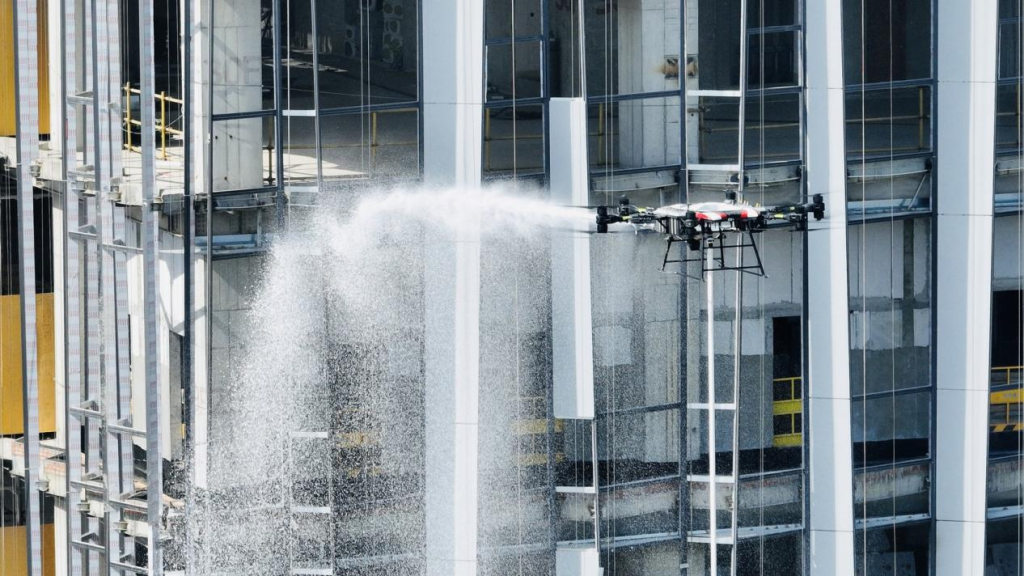
A firefighting equipment R&D unit, during the development of a high-rise building firefighting robot, required a solution to rapidly and stably lower/raise a firefighting pod from the rooftop to any floor up to 200 meters below. The total weight of the pod and its integrated firefighting equipment exceeded 1 ton. Simultaneously, three critical issues needed resolution: power supply, signal transmission, and high-pressure water supply.
KLD designed a seven-winchester servo-driven winch system based on a 1 primary load-bearing + 4 auxiliary support + 1 cable winch + 1 hose winch architecture, enabling coordinated control of wire rope loads, power/signal cables (umbilical), and firefighting hoses.
1. Project Background & Industry Pain Points
In high-rise building fire rescue scenarios, firefighting equipment faces a core conflict:
Fire ladder truck height is limited (typically ≤ 100m)
Firefighters climbing stairs with equipment is time-prohibitive
Conventional winch systems cannot simultaneously address load-bearing, power supply, and water supply
Using a standard winch for firefighting equipment leads to the following issues:
Common Problems:
Single-point lifting causes pod rotation and sway
Pod attitude is difficult to control under high-altitude wind loads
Wire rope and cable entanglement/knotting
Hose kinking leading to water supply interruption
Excessive cable tension causing signal loss
Speed mismatch among multiple winches, resulting in pod tilt
Loss of pod position after power failure, requiring recalibration
Therefore, a purpose-designed multi-unit coordinated servo winch system is essential for stable and safe firefighting pod lifting operations.
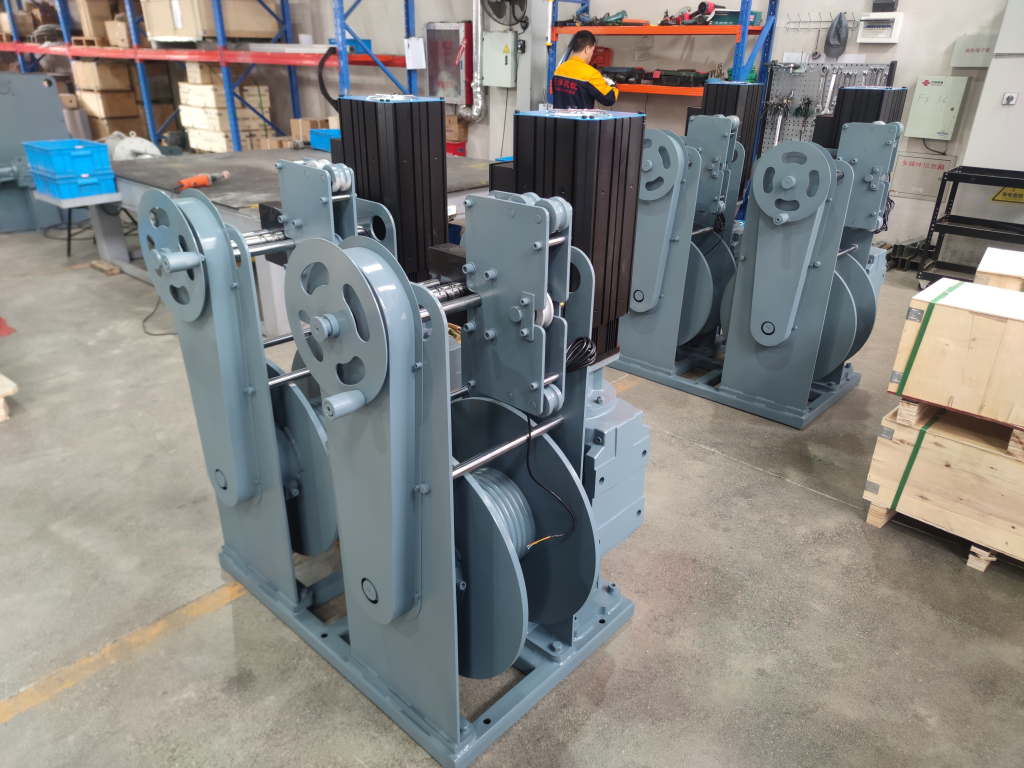
Wire rope load winch (structural load bearing)
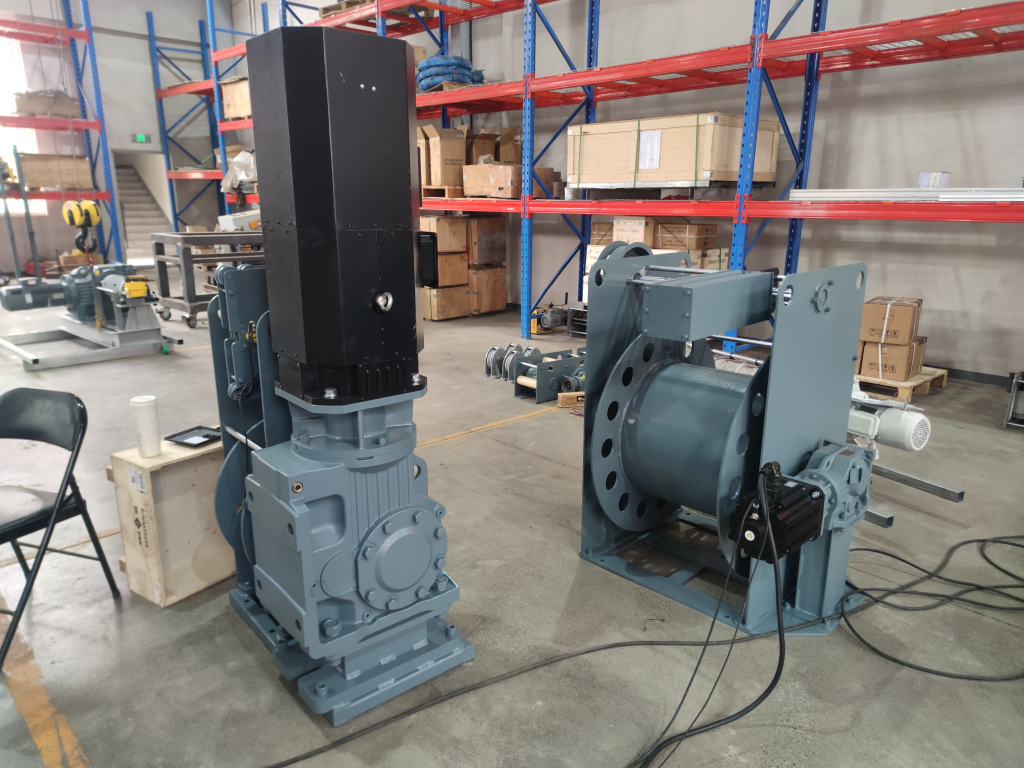
Cable umbilical winch (power & signal transmission)
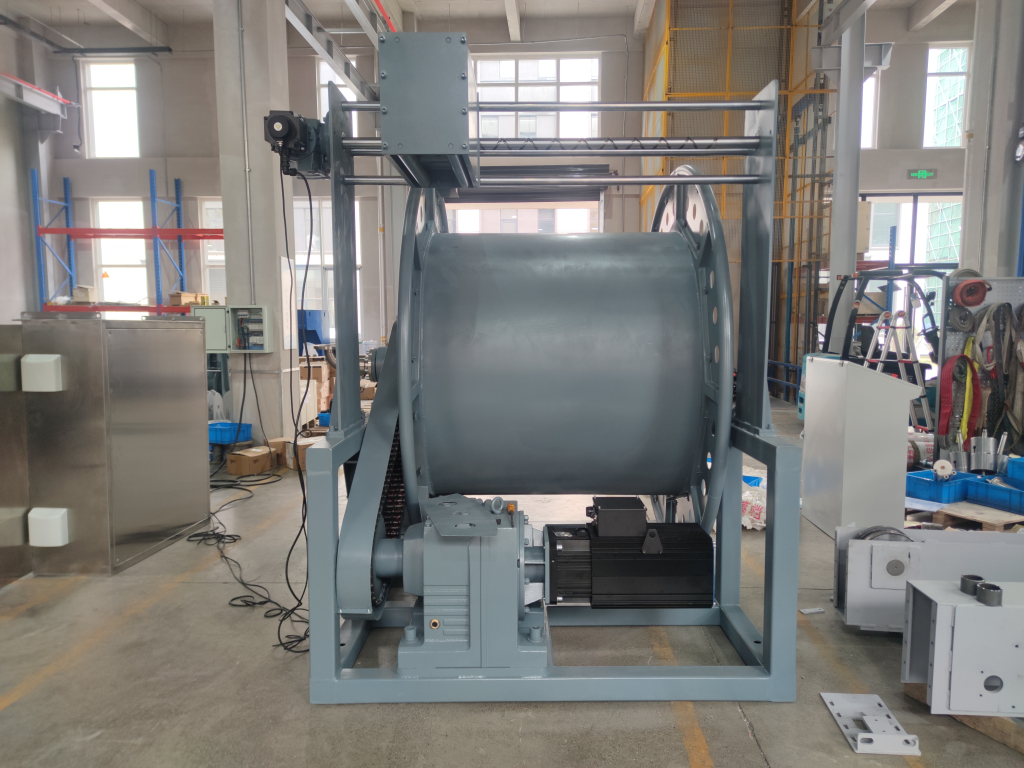
Hose winch (firefighting water supply)
2. Core Customer Technical Requirements
Key customer requirements included:
1️⃣ Simultaneous pay-in/pay-out of three media types (wire rope, cable, high-pressure hose) without interference
2️⃣ Coordinated control of seven winches with speed deviation ≤ 0.5%
3️⃣ Lifting height capability of 100 m
4️⃣ Maintain pod stability under high-altitude wind loads (no sway, no rotation)
5️⃣ Retain pod position memory after power loss (no re-homing required)
6️⃣ Support industrial bus control (Profinet/EtherCAT) for integration with main firefighting control system
7️⃣ Water swivel joint rated for 1.6 MPa without leakage; Electrical swivel joint supporting 40-50 signal cores
8️⃣ Equipment must fit a rooftop mobile platform (width 2800 mm, horizontal layout)
3. KLD Custom Solution
KLD developed a 1+4+1+1 Seven-Winch Servo-Driven System for this specific high-rise firefighting robot application:
| Equipment Type | Qty | Core Role | Function Description |
|---|---|---|---|
| Primary Load-Bearing Winch | 1 | Absolute core | Main lifting point, carries the majority of the load |
| Auxiliary Load-Bearing Winches | 4 | Synchronized support | Work with primary winch to maintain pod leveling & stability |
| Cable Umbilical Winch | 1 | Neural center | Dedicated to robot power supply & signal transmission |
| Hose Winch | 1 | Water supply lifeline | Dedicated to high-pressure firefighting hose pay-in/pay-out |
Total: 7 units
4. Core Technical Specifications
4.1 Primary Load-Bearing Winch
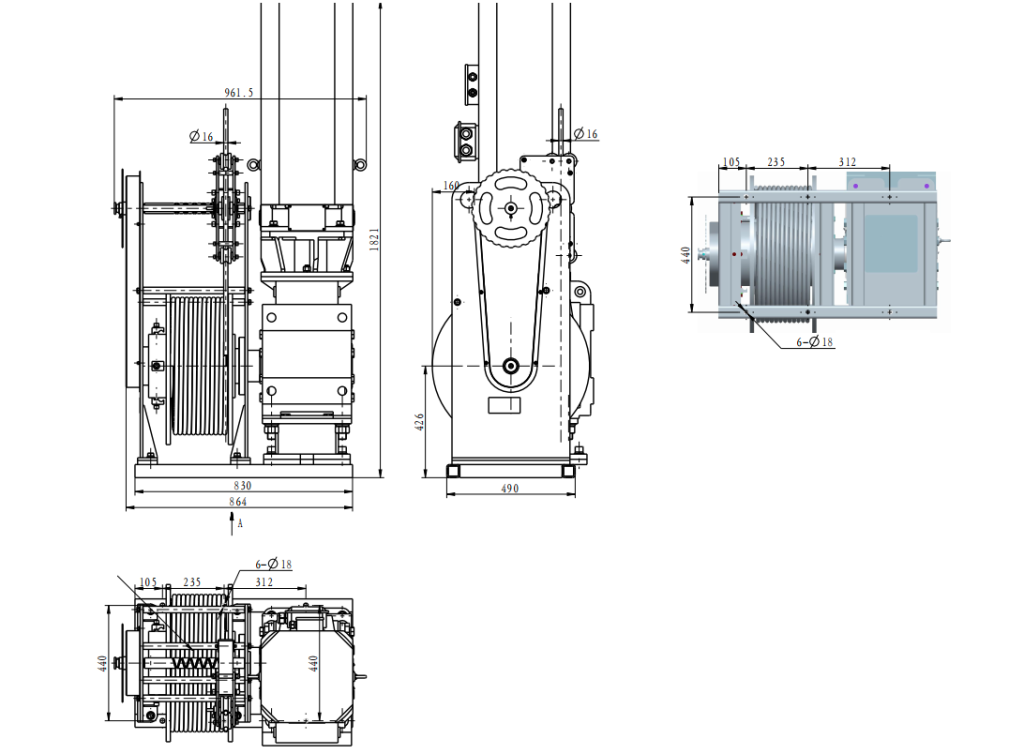
| Parameter | Value |
|---|---|
| Model | PJR-1500 |
| Rated Lifting Capacity | 1500 kg |
| Servo Motor Power | 45 kW |
| Motor Features | Dual-brake system |
| Gearbox Ratio | 14.43:1 |
| Gearbox Output Torque | 3939 N·m |
| Pay-out Speed | 2.05 m/s |
| Max Lifting Height | 100 m |
| Wire Rope Diameter | 16 mm |
| Drum Base Diameter | 237 mm |
| Winding Layers x Turns | 9 layers x 12 |
| Rope Capacity | 120 m |
| Self Weight | 1000 kg |
4.2 Auxiliary Load-Bearing Winches (4 units)
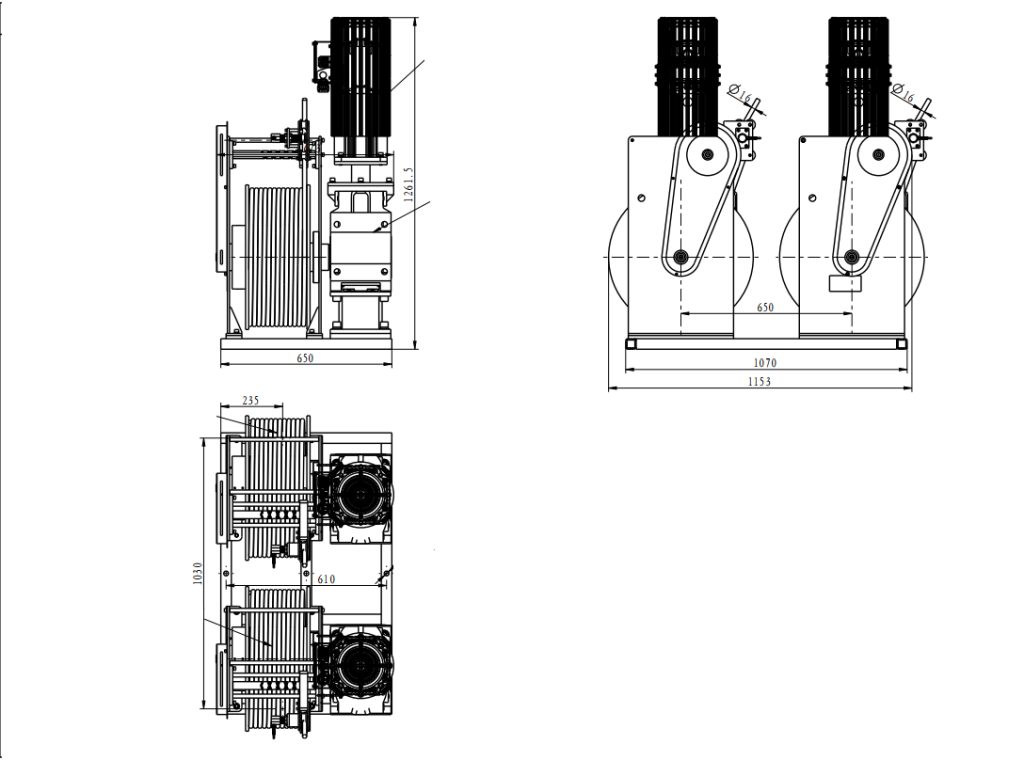
| Parameter | Value |
|---|---|
| Model | PJR-1000 |
| Rated Lifting Capacity | 1000 kg |
| Servo Motor Power | 15 kW |
| Motor Features | Brake system |
| Gearbox Ratio | 14.45:1 |
| Gearbox Output Torque | 1333 N·m |
| Pay-out Speed | 0.1 m/s |
| Max Lifting Height | 100 m |
| Wire Rope Diameter | 16 mm |
| Drum Base Diameter | 237 mm |
| Winding Layers x Turns | 9 layers x 12 |
| Rope Capacity | 120 m |
| Self Weight | 750 kg |
4.3 Cable Umbilical Winch
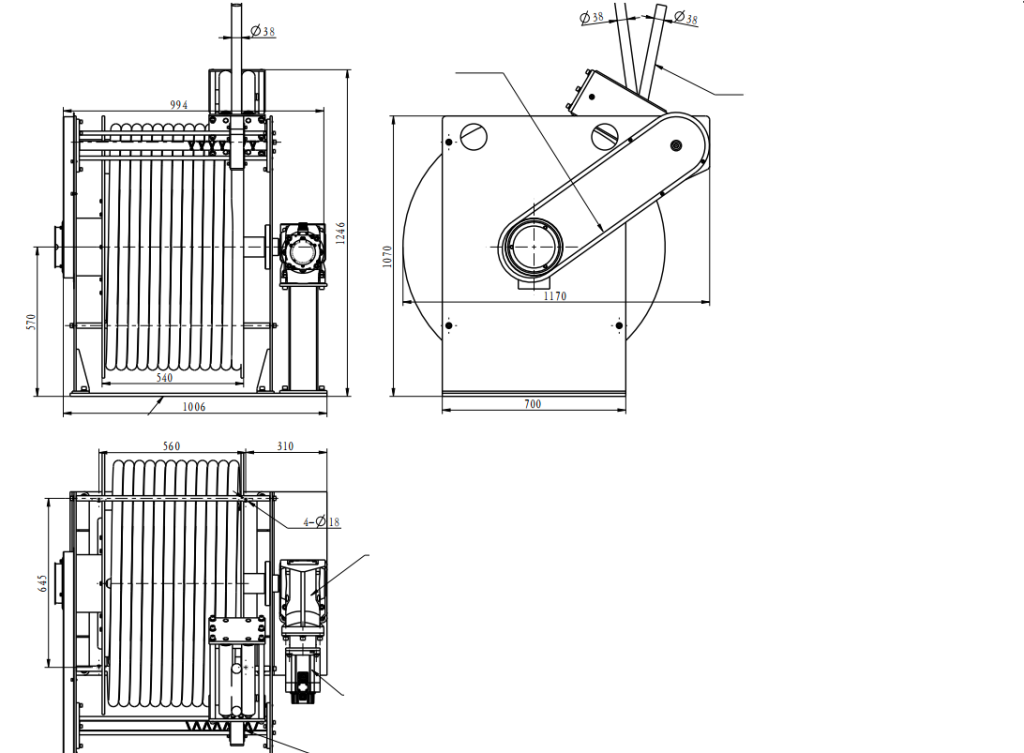
| Parameter | Value |
|---|---|
| Model | PJR-200 |
| Rated Lifting Capacity | 224 kg |
| Servo Motor Power | 5.5 kW |
| Motor Features | Brake system |
| Gearbox Ratio | 24:1 |
| Gearbox Output Torque | 823 N·m |
| Pay-out Speed | 2.31 m/s |
| Max Lifting Height | 100 m |
| Cable Diameter | 35 mm |
| Drum Base Diameter | 560 mm |
| Winding Layers x Turns | 5 layers x 12 |
| Cable Capacity | 120 m |
| Self Weight | 230 kg |
4.4 Hose Winch
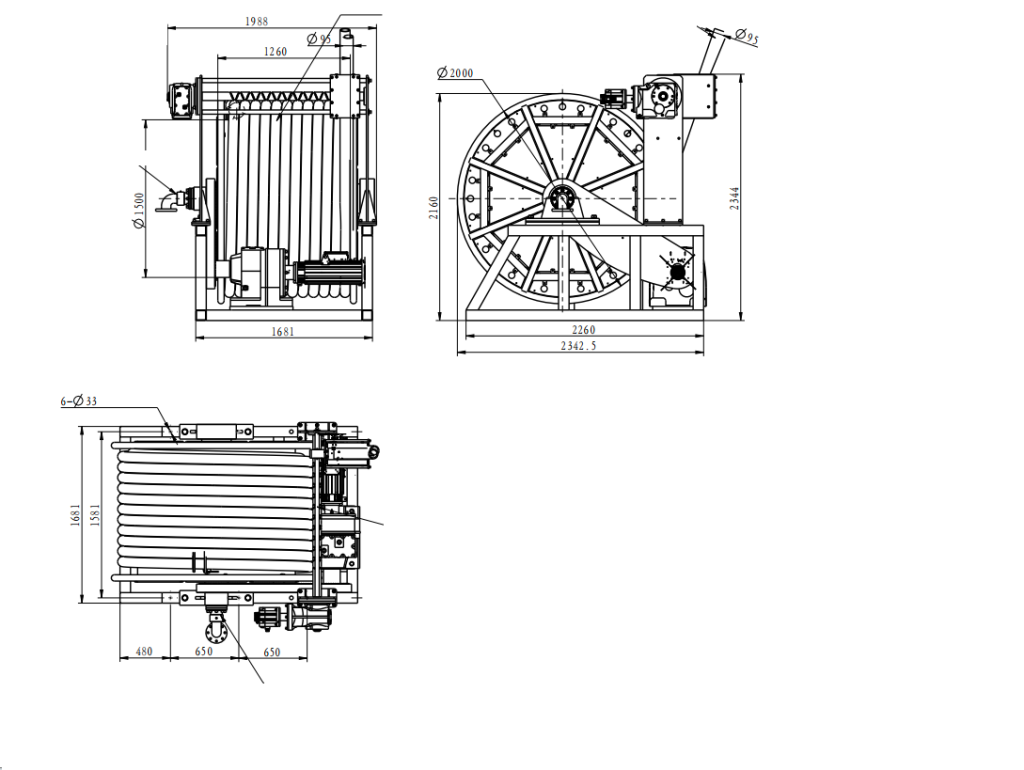
| Parameter | Value |
|---|---|
| Model | PJR-106 |
| Layer 1 Lifting Capacity | 1223 kg |
| Layer 2 Lifting Capacity | 1093 kg |
| Servo Motor Power | 30 kW |
| Motor Features | Brake system |
| Gearbox Ratio | 52.87:1 |
| Gearbox Output Torque | 9752 N·m |
| Layer 1 Pay-out Speed | 2.34 m/s |
| Layer 2 Pay-out Speed | 2.62 m/s |
| Max Lifting Height | 100 m |
| Hose Specification | DN80 (OD 95±5 mm) |
| Drum Outer Diameter | 1500 mm |
| Winding Layers | 2 |
| Hose Capacity | 117 m |
| Self Weight | 2450 kg |
| Special Features | 90° elbow water swivel, hose level wind |
5. Design Highlights
✔ 1 Primary + 4 Auxiliary = 5-Point Support
One 1500kg primary winch as main lifting point, four 1000kg auxiliary winches at pod corners creating a 5-point support structure, effectively preventing pod sway and rotation.
✔ Complementary Speed Control
Primary winch pay-out speed 2.05 m/s for rapid lifting; Auxiliary winches pay-out speed 0.1 m/s for precision positioning. Different operational phases balance efficiency and accuracy.
✔ Independent Function, No Interference
Cable and hose winches are independent systems, not participating in load sharing – control logic remains clean.
✔ Absolute Encoders + Industrial Bus
Each winch equipped with an absolute encoder for position memory after power loss. Supports Profinet, Modbus/TCP, EtherCAT, and other industrial bus protocols.
✔ Water Swivel + Electrical Swivel
Water swivel rated 1.6 MPa, leakage ≤ 0.1 L/h. Electrical swivel supports 40-50 signal cores, including 1x Cat6a Ethernet, 8x 16A power lines, 12x 10A signal lines.
✔ Horizontal (Low-Profile) Structure
Entire system designed for horizontal installation, fitting rooftop mobile platforms with 2800 mm width.
6. Application Scenarios
High-rise building (200m+) firefighting robot pod lift systems
Rooftop mobile firefighting platforms (width 2800 mm)
Complex firefighting systems requiring simultaneous load-bearing, power supply, and water supply
Firefighting, emergency rescue, and military lifting applications
7. Project Value
This solution achieves:
5-point support – significantly improved wind load resistance for the pod
7-unit coordinated control – speed deviation ≤ 0.5%
Water swivel joint – 1.6 MPa with no leakage
Electrical swivel – stable 40-50 core signal transmission
No re-homing required after power loss – rapid operational recovery
Clear 1+4+1+1 architecture – simple maintenance
8. Customization & Inquiry
Company: Beijing Tianheng Kairui (KLD Winch)
Website: https://kldwinch.com
Custom Services: One-on-one technical proposals and dedicated quotations. Please contact us with your requirements.
✔ Factory direct – cost advantage
✔ Custom drawings supported
✔ Adjustable 1+N auxiliary configuration
9. FAQ
Q1: What is the braking system of the primary load-bearing winch?
A: The servo motor incorporates a dual-brake system. Two independent brake systems ensure safety for high-altitude operations.
Q2: How is synchronization among the seven winches achieved?
A: Each winch is equipped with an absolute encoder and supports industrial bus control (Profinet, Modbus/TCP, EtherCAT). Speed deviation is controlled to within 0.5%.
Q3: Is pod position lost after a power failure?
A: No. Absolute encoders retain the absolute position before power loss. After power restoration, the system can resume operation without re-homing.
Q4: What is the maximum pressure rating for the water swivel joint?
A: The design rating is 1.6 MPa. No leakage occurs under static or dynamic conditions; leakage ≤ 0.1 L/h.
Q5: What signals does the electrical swivel support?
A: Supports 40-50 signal cores, including 1x Cat6a Ethernet line, 8x 16A power lines, and 12x 10A signal lines.

