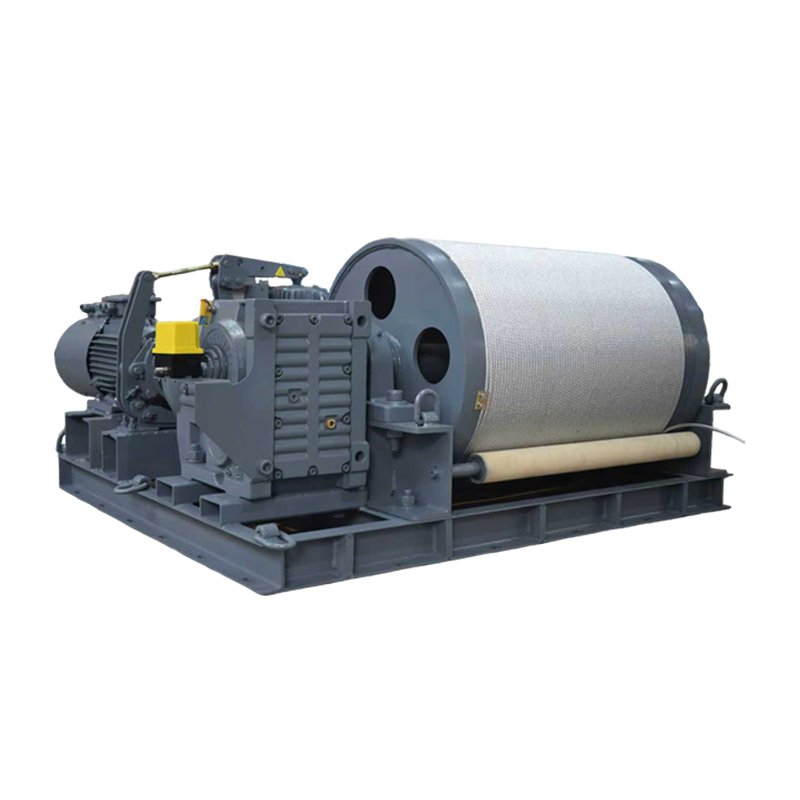
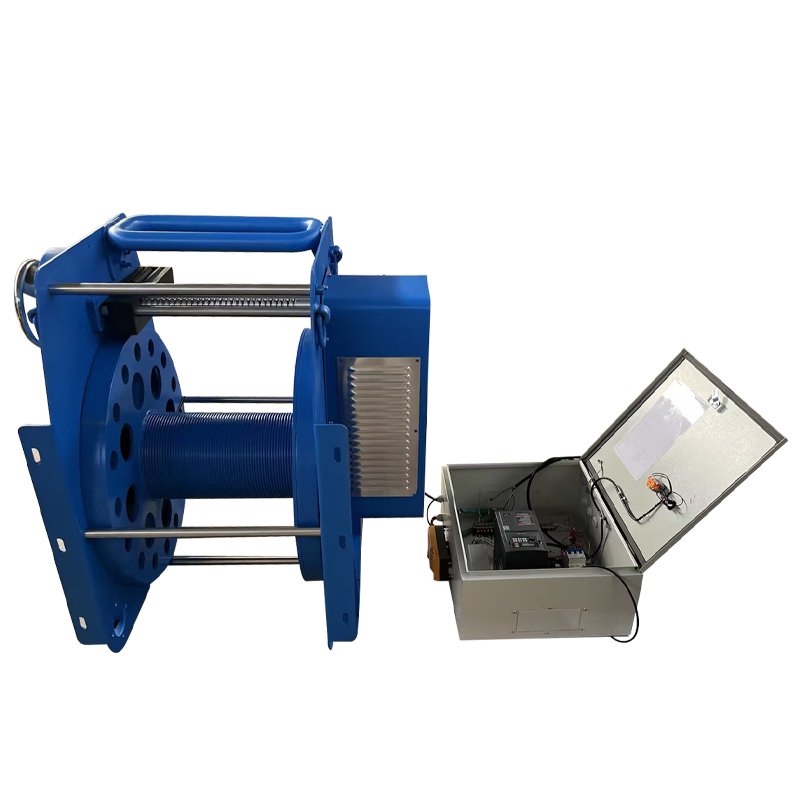
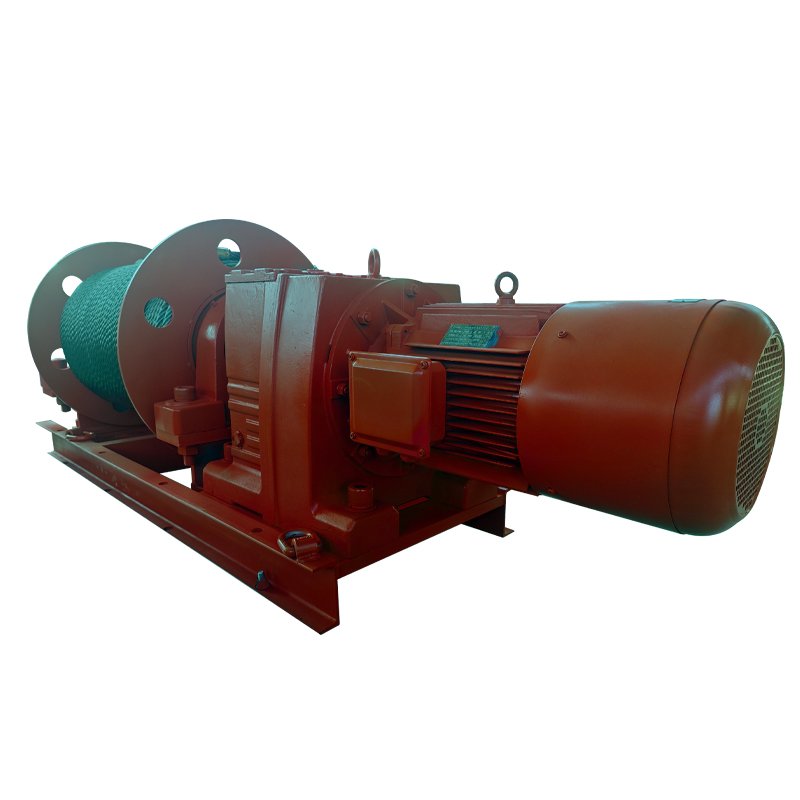
Diseñado para entornos de elevación críticos, nuestro Cabrestante industrial de tambor automático representa la próxima generación de cabrestante eléctrico de alta resistencia tecnología. A diferencia de los modelos estándar, esta unidad utiliza una tecnología premium Caja de cambios combinada doble serie K, ofreciendo un par y una eficiencia óptimos dentro de un chasis notablemente compacto y estéticamente agradable.
Ya sea que se implemente en almacenamiento logístico o operaciones de rescate especializadas, Su mecanismo de autoenrollado integrado mejora la estabilidad operativa y optimiza el uso del espacio. No es solo un cabrestante; es un sistema integral. cabrestante de cable eléctrico Solución diseñada para mejorar la eficiencia del trabajo y garantizar la absoluta seguridad operativa bajo cargas de hasta 10.000 kg.
A 5000 kg industrial winch built around a self-spooling rope arrangement. A K127K87 K-series double-combination gearbox at 473:1 takes a 3 kW four-pole braked motor down to 3 rpm at the drum, producing 8494 N.m of output torque and a rope speed of 0.05 m/s. The Ø24 mm wire rope pays out at an angle over a fixed sheave, and a leadscrew-driven spooling carriage lays it across the Ø325 mm drum so the wraps stay ordered instead of piling in one place. Lifting height is 12 m from a 15.5 m drum capacity. An emergency hand crank sits at the rear of the motor for use when power is lost, and a mechanical height limiter works alongside a travel limit for end-of-travel protection.
Quick Specs
Rated pull: 5000 kg
Motor: four-pole, braked, 3 kW, 380 V
Gearbox: K127K87-3kW-473-4P, ratio 473:1
Reducer output speed: 3 rpm
Rated output torque: 8494 N.m
Rope speed: 0.05 m/s (3 m/min)
Application Scenarios and Applicable Boundaries
- Vertical hoisting with a defined travel of up to 12 m, where a fixed-speed slow pull suits the duty
Features Benefits
A leadscrew runs parallel to the drum and carries a travelling guide. As the drum turns, the guide traverses at a rate matched to the rope diameter, so each wrap lands beside the previous one. The leadscrew is driven from the drum through a chain, with the chain covered by a guard, which is why the spooling stays synchronised with drum rotation without a separate motor or controller. The rope leaves the drum at an angle, passes over a fixed sheave carried on the machine, and then runs to the load. Leading the rope over a sheave before it leaves the machine fixes the exit point, so the fleet angle onto the drum is set by the machine rather than by wherever the load happens to be. On a spooled drum that matters, because a varying fleet angle is what causes the rope to cross wraps. A hand-crank interface with a guard is fitted at the rear of the motor. When power is lost, the crank is fitted to the interface and turned by hand to raise or lower the load. The crank is removed and stowed when not in use — the drawing states this explicitly, and it matters, because a crank left on a rotating shaft is a hazard.
Modelo: 5000 KG
Potencia del motor: 3KW
Relación de transmisión de la caja de cambios: 473:1
Velocidad de salida del reductor: 3 r/min
Par de salida: 8494 N.m
Velocidad de salida de la cuerda: 0,05 m/s
Peso de levantamiento: 5000 kg
Altura de elevación: 12 m
Peso propio: 1230 kg
Diámetro del cable de acero: 24 mm
Diámetro del tambor: 325 mm
Modelo: 5000 KG
A (Longitud): 1221 mm
B(Ancho): 1006 mm
C(Altura): 891 mm
Size Installation and System Interface
1. Rated pull is 5000 kg on the rope. Confirm the base plate and the structure it sits on carry that pull reaction, plus the 1230 kg machine weight. The four Ø39 mm holes indicate substantial anchor bolts — size them for the reaction, not for the dead weight alone.
2. The fixed sheave must sit at least 2000 mm from the spooler rope exit. This is a hard minimum, not a recommendation: a shorter distance produces an excessive fleet angle at the spooler and the rope will not lay correctly. The drawing prints this as "2000m"; it is 2000 mm.
Control Safety and Protection
3 kW four-pole braked motor, 380 V, through a K127K87 double-combination gearbox at 473:1. Drum speed 3 rpm; rope speed 0.05 m/s fixed.
Speed control: single speed. Variable speed requires the optional inverter control panel.
Manual: hand-crank interface at the rear of the motor, with guard; crank removed and stowed when not in use.
End of travel: mechanical height limiter (17:1) plus a travel limit — two independent devices.
Spooling: leadscrew carriage chain-driven from the drum; synchronised by mechanical linkage, with no separate motor or controller.
Brake: integrated on the four-pole motor.
Customization Options and Engineering Process
Configured around your operating conditions — Share the required line pull, rope travel, operating speed, duty cycle, power supply, installation envelope and environment. KLD will review the application and provide a proposed configuration, technical drawing and quotation for approval. Free design schematics are provided for different scenarios.
Requirements → Concept → Drawing & Quotation → Approval → Production & Test → Delivery
Standards Testing and Quality
The company operates an ISO 9001 quality management system. CE conformity documents (LVD, EMC) are available for applicable configurations on request. Classification certificates (e.g. LRS / BV / ABS / DNV GL) can be arranged as an optional item for marine applications.

Factory testing follows the approved technical specification for each configured unit and may include: no-load run, rated-load operation, brake function, limiter function and control verification. Available documentation may include dimensional drawings, electrical diagrams, inspection records and functional test results, depending on project scope.
Engineering Cases
a 5000 kg lifting duty over a 12 m travel, at low speed, where the rope had to lay evenly on the drum without an operator guiding it, and where the site needed a manual fallback for power outages.
Most winches are custom-made products; lead time is confirmed after technical approval and order review. Project support can include configuration review, drawing approval, factory testing, export packaging, remote commissioning support and recommended spare parts. On-site measurement and installation support are available for applicable projects.
What are the case specifications?
Model TH2496.00 auto rope-spooling industrial winch. Rated pull 5000 kg. 3 kW four-pole braked motor at 380 V through a K127K87 double-combination gearbox at 473:1, giving 3 rpm at the drum and 8494 N.m of output torque. Rope speed 0.05 m/s fixed. Lifting height 12 m. Machine weight 1230 kg. Ø24 mm wire rope, Ø325 mm drum, 15.5 m capacity, 30 m total rope, angled payout through a fixed sheave. Leadscrew spooling carriage, height limiter 17:1 plus travel limit, safety stop pin, hand-crank interface at the motor rear. Outline A 1221 × B 1006 × C 891 mm, four Ø39 mm mounting holes.
How much overload can it take?
Very little, and we would rather say so plainly than let you find out on site. At 5000 kg and 0.05 m/s the rope work is 2452 W; with a typical 0.85 efficiency the motor needs 2885 W, against a 3 kW rating — a margin of 1.8 percent. That means the drive is matched to the rated point with essentially no reserve. If the load is underestimated, the supply is low or unbalanced, or the rope path adds friction, there is nothing left to absorb it. Please size your application within 5000 kg and tell us if the duty is anything other than a steady lift.
Is the rope payout horizontal or angled?
Angled — the rope runs upward over a fixed sheave carried on the machine, then to the load. The drawing's parameter item 10 says "horizontal payout", but that conflicts with the drawing's own three views, with the product description and with the detail page, all of which show the rope angled upward through the sheave. We treat the angled payout as correct and have flagged the drawing text for correction. This matters for your layout: an angled payout needs headroom above the machine, a horizontal one does not.





 Linkedin
 Google +