


Friction winches can provide the traction stage of an airship tether system, with a separate take-up winch handling retrieval and storage. This arrangement gives each unit a defined role when a project combines substantial pulling requirements with long tether travel.
For an airship wind-power research project, KLD designed a combined system with front-end friction traction, rear take-up, tension and length sensing, servo drives, and PLC control. The engineering task covered the relationship between those components throughout tether handling. This case explains the proposed arrangement, its project requirements, and the information buyers need when evaluating a similar system.
Project Requirements for a High-Altitude Airship
The project required ground equipment for airship traction, launch, and recovery at a site approximately 3,000 metres above sea level. The client was the Aerospace Information Research Institute, Chinese Academy of Sciences, and the application involved high-altitude wind-power research.
The airship’s intended operating range was in the 10,000-metre class, alongside a tether requirement in the same length class. Site elevation, airship altitude, and tether length describe separate engineering conditions. Their reference points and operating limits need to be defined individually in the approved specification.
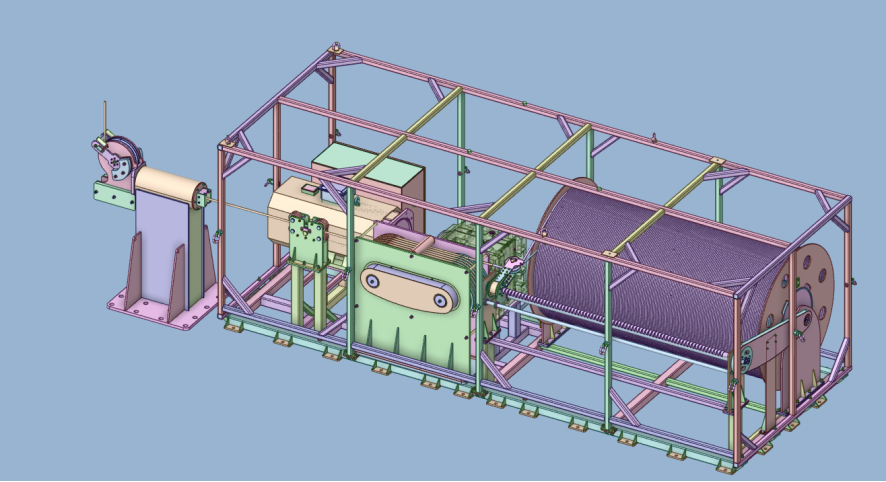
| Project Item | Requirement or Configuration |
| Application | Airship tether handling for high-altitude wind-power research |
| Site elevation | Approximately 3,000 m above sea level |
| Intended airship operating range | 10,000-metre class; altitude reference to be confirmed |
| Tether length requirement | 10,000-metre class; exact installed storage capacity to be confirmed |
| Project traction requirement | Specified as “8,000 kg”; force unit and rating basis require confirmation |
| Front unit | Friction winch for main traction |
| Rear unit | Take-up winch with a level-wind mechanism |
| Instrumentation | Tension sensor and tether length sensor |
| Drive and control | Servo motors and PLC; automatic take-up speed matching specified |
The traction entry needs particular care. Kilograms express mass, so the project’s quoted value requires a confirmed force-unit definition before it can be used in a rated line-pull specification. It also does not establish an airship payload rating.
How Friction Winches and Take-Up Winches Share the Work
The front winch provides the main traction, while the rear winch retrieves and stores the tether. This division allows the design review to address pulling requirements and rope-storage requirements separately, then check their operation as a combined system.
Front-End Friction Traction
In general, a friction winch transfers pulling force through contact between the tether and its traction surface. Rope compatibility and contact conditions therefore matter when specifying the equipment. The required contact arrangement must be established through the actual design.
In this project, the front friction winch carries the main traction task and includes tension and length sensing. Buyers reviewing other friction winch configurations should check the intended application of each design. The linked assembly-line example has its own operating requirements and specifications.
Rear Take-Up and Level Winding
The rear unit handles tether retrieval. Its level-wind mechanism guides the tether into an orderly arrangement as it enters storage.
For a long-tether installation, the storage review should cover usable drum volume, tether diameter, winding arrangement, and reserve length. These inputs determine whether the selected take-up unit can accommodate the required tether. A length requirement alone cannot establish storage capacity.
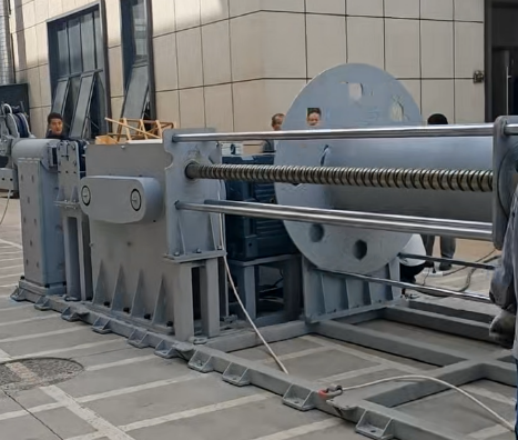
This traction-and-take-up layout is worth evaluating when pulling and storage need separate equipment functions. Suitability still depends on the complete rope path, load cases, and control requirements.
Tension Measurement, Tether Travel, and PLC Coordination
The sensors provide two different measurements: traction force and tether travel. Keeping those measurements distinct helps engineers define what the control system can use and what additional information the wider airship system needs.
The tension sensor measures pulling force during tether handling. Its required range, accuracy, and calibration arrangements should be agreed during engineering review.
The length sensor records tether movement. It does not directly measure the airship’s altitude. Position assessment requires an appropriate relationship between tether length, geometry, and the project’s other measurements.
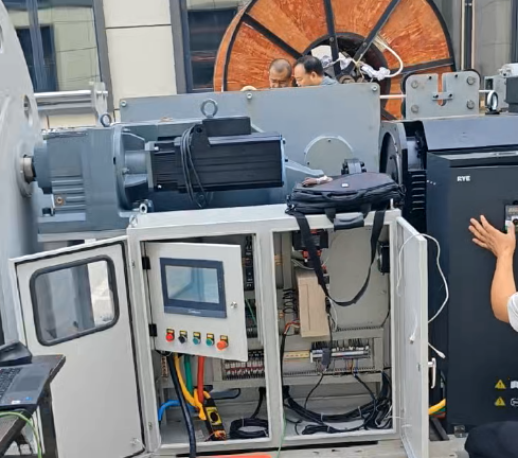
The specified drive arrangement uses servo motors and a PLC. The project calls for the PLC to match take-up speed automatically to friction-winch operation. That requirement defines the intended coordination between the units; measured tracking accuracy and acceptance performance require separate verification.
During design review, engineers should distinguish tether travel speed from drum rotational speed. The relationship depends on the effective winding diameter. The supplier should explain how the approved arrangement addresses that relationship through the working storage range.
KLD’s separate airship test winch configuration illustrates another application of load and length monitoring. Its specifications belong to that configuration and should be evaluated independently.
Specifying a Dual-Rope Winch: Rope Count and Winch Roles
A dual-rope winch inquiry should define the number of ropes and how each rope is handled. For this case, the established arrangement consists of separate friction-traction and take-up units. The available configuration details do not confirm two independently handled ropes.
Before specifying a Dual-Rope Winch, identify each rope path, its load cases, and whether separate control is required. Include a routing sketch showing the connection between the airborne equipment and the ground machinery.
Winch count, drum count, and rope count are separate design details. Each belongs on the system drawing. Any requirement for redundant tethering also needs an explicit engineering definition and assessment. The presence of two winches alone does not establish a redundant tether arrangement.
Engineering Inputs for a Similar Tether System
A useful inquiry describes the operating sequence as well as the required pull. For a comparable airship tether system, prepare the following inputs:
- Load cases: required line pull in a confirmed force unit, normal operating loads, and the conditions used to establish the rating.
- Tether specification: material, diameter, mass per metre, bending limits, working length, and storage allowance.
- Motion requirements: payout and retrieval speeds, operating duration, start and stop conditions, and coordination requirements.
- Site interfaces: elevation, temperature range, power supply, mounting space, anchoring conditions, and rope exit direction.
- Measurement and acceptance: sensor ranges and accuracy, required control functions, test conditions, and acceptance criteria.
Applicable standards, design factors, braking requirements, and third-party inspection scope should be agreed for the actual project. They need to be recorded in the approved technical specification before they become contractual requirements.
When reviewing custom winch solution cases, compare the operating task and system interfaces with your own application. A case becomes useful when it explains which functions the arrangement provides and which engineering inputs remain necessary for selection.
For procurement, request a proposal that connects each requirement to a component, drawing, calculation, or planned verification. This gives the buyer a practical basis for reviewing the complete tether-handling system.
Discuss an Airship Tether Winch Project With KLD
KLD’s custom winch process covers requirement discussions, operating-condition analysis, solution design, parameter confirmation, manufacturing and testing, and delivery support. This project applies that approach to the combination of friction traction and separate tether take-up.
To request a tether winch design review, send the operating sequence, required line pull, tether specification, and a rope-routing sketch. Identify which requirements are fixed and which need engineering assessment so the proposed scope and verification plan can be defined.
FAQ
Q1: Does the Project’s “8,000 kg” Traction Value Specify Airship Payload?
A: No. It expresses a project traction requirement using a mass unit. The intended force unit and rating basis must be confirmed before the value is used for equipment selection. Airship payload requires its own definition; it cannot be inferred from this traction entry.
Q2: Does a 10,000-Metre-Class Tether Requirement Confirm Installed Drum Capacity?
A: No. Confirm the exact capacity against the approved drum geometry, tether specification, winding arrangement, and reserve allowance. Friction winches provide the traction function in this layout, while the separate storage unit needs a capacity assessment for the chosen tether.
Q3: Can a Tether Length Sensor Determine the Airship’s Altitude?
A: The sensor measures tether travel. Altitude assessment requires the relevant geometry and other measurements defined by the project. Buyers should agree on the required altitude reference and measurement method separately from the tether-length function.
Q4: Does a Traction-and-Take-Up Arrangement Qualify as a Dual-Rope Winch?
A: That designation requires confirmation of the rope arrangement. This case establishes two winch functions, with rope count remaining unconfirmed. Ask for a routing drawing that identifies every rope, its function, and its connection to the ground equipment.
Q5: What Test Evidence Should a Buyer Request for PLC Speed Coordination?
A: Request an agreed test procedure and recorded results covering the relevant speed range, operating transitions, and load conditions. Define acceptance limits before testing. Those records would support a coordination-performance claim; completed results are not established for this case.

